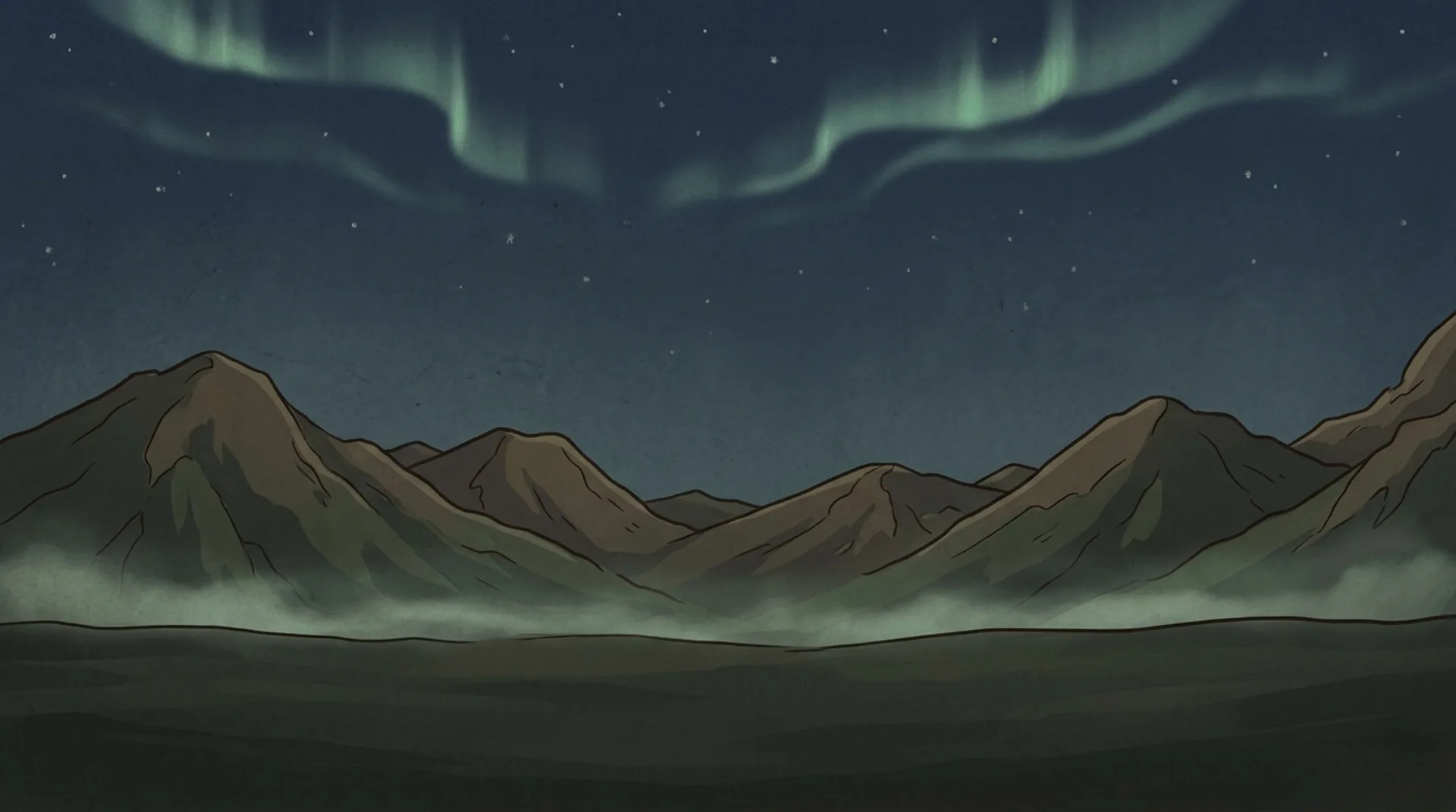
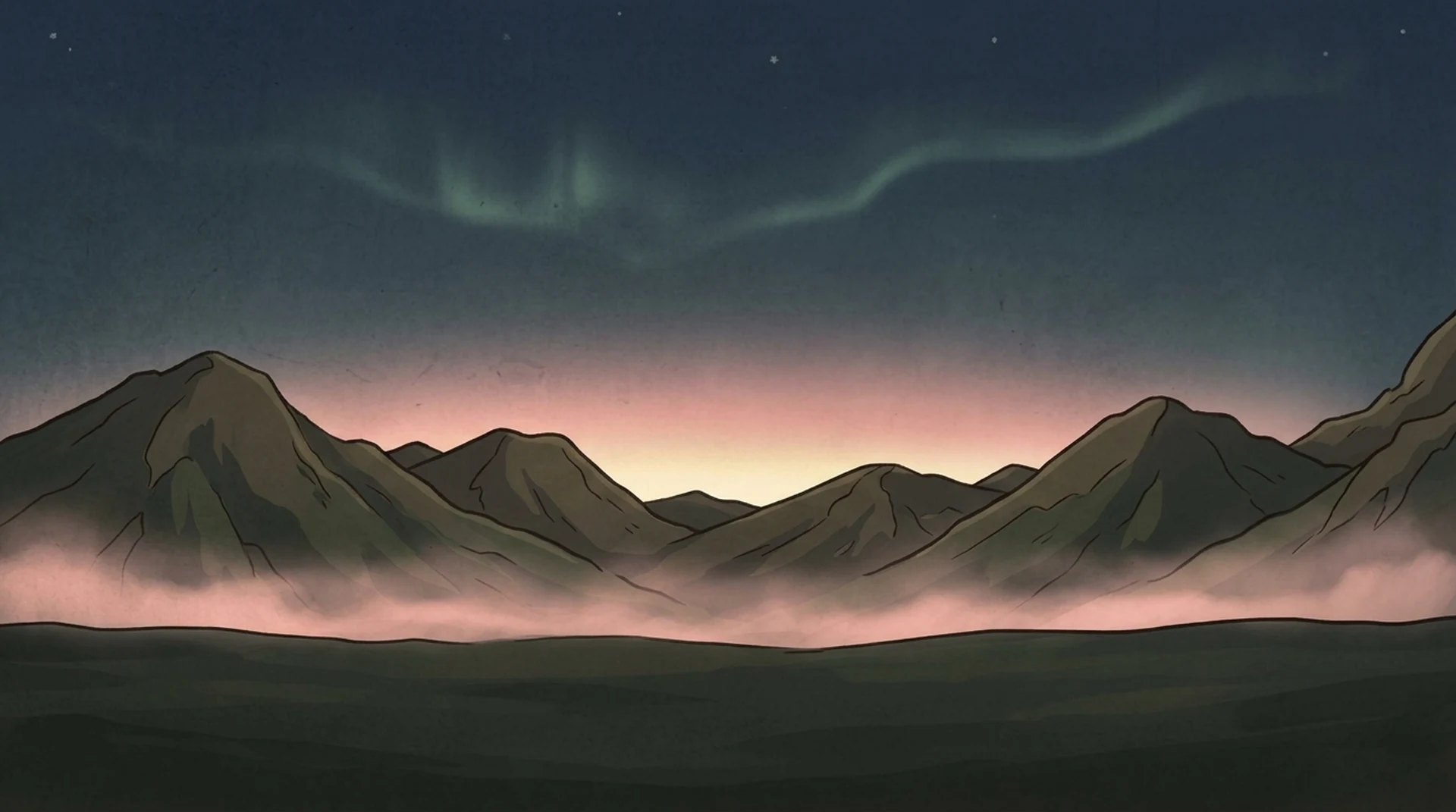
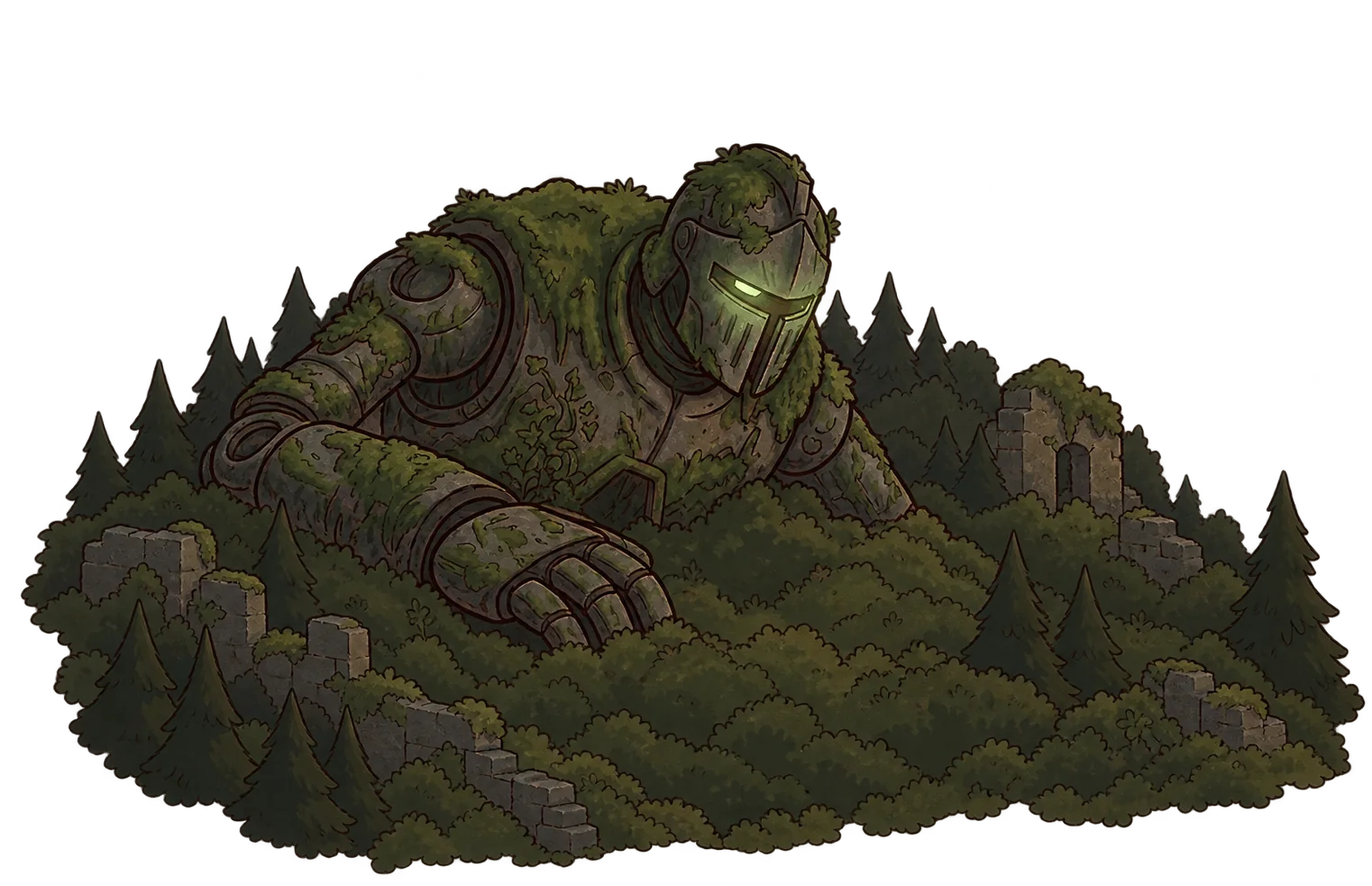
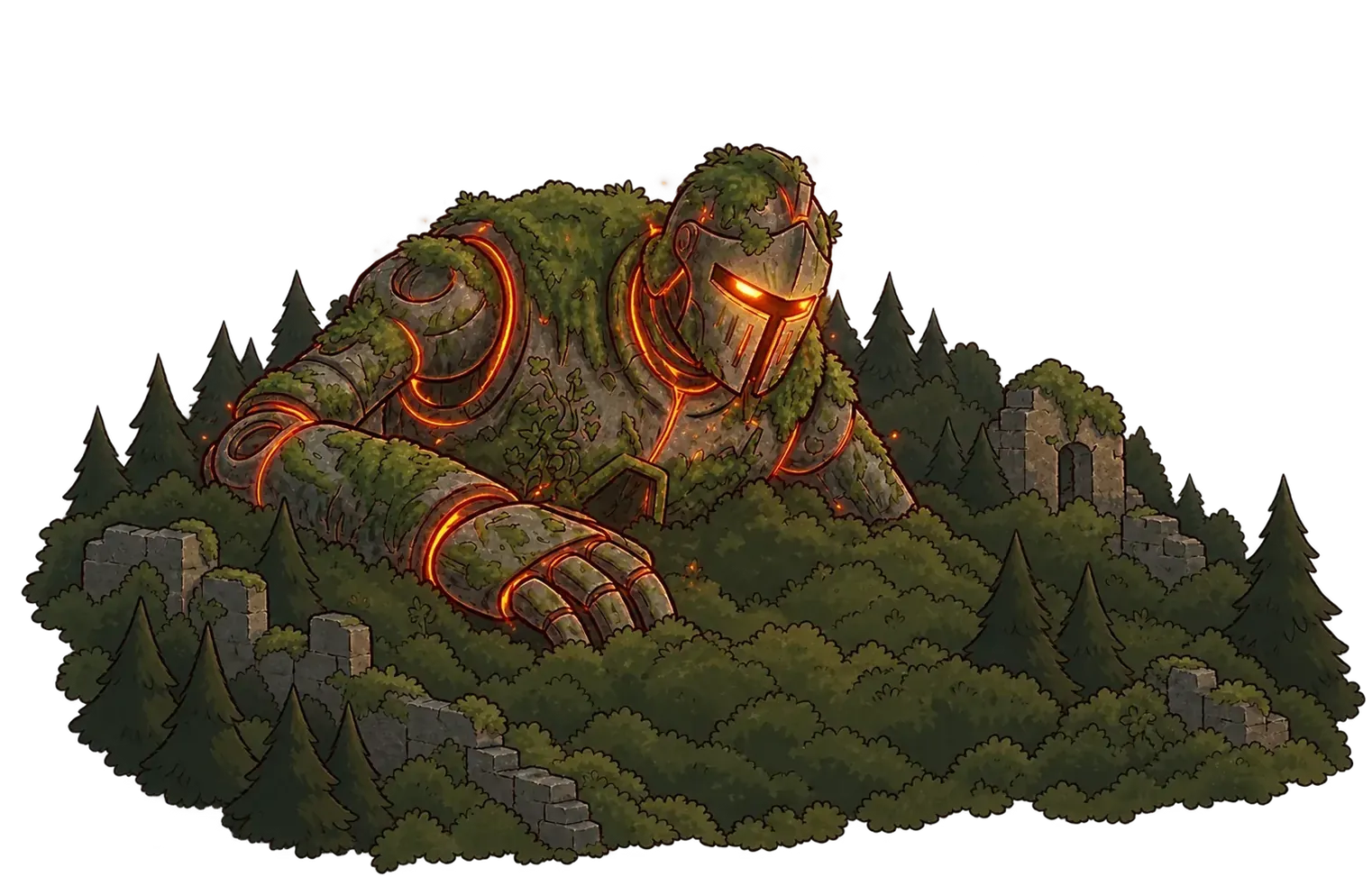
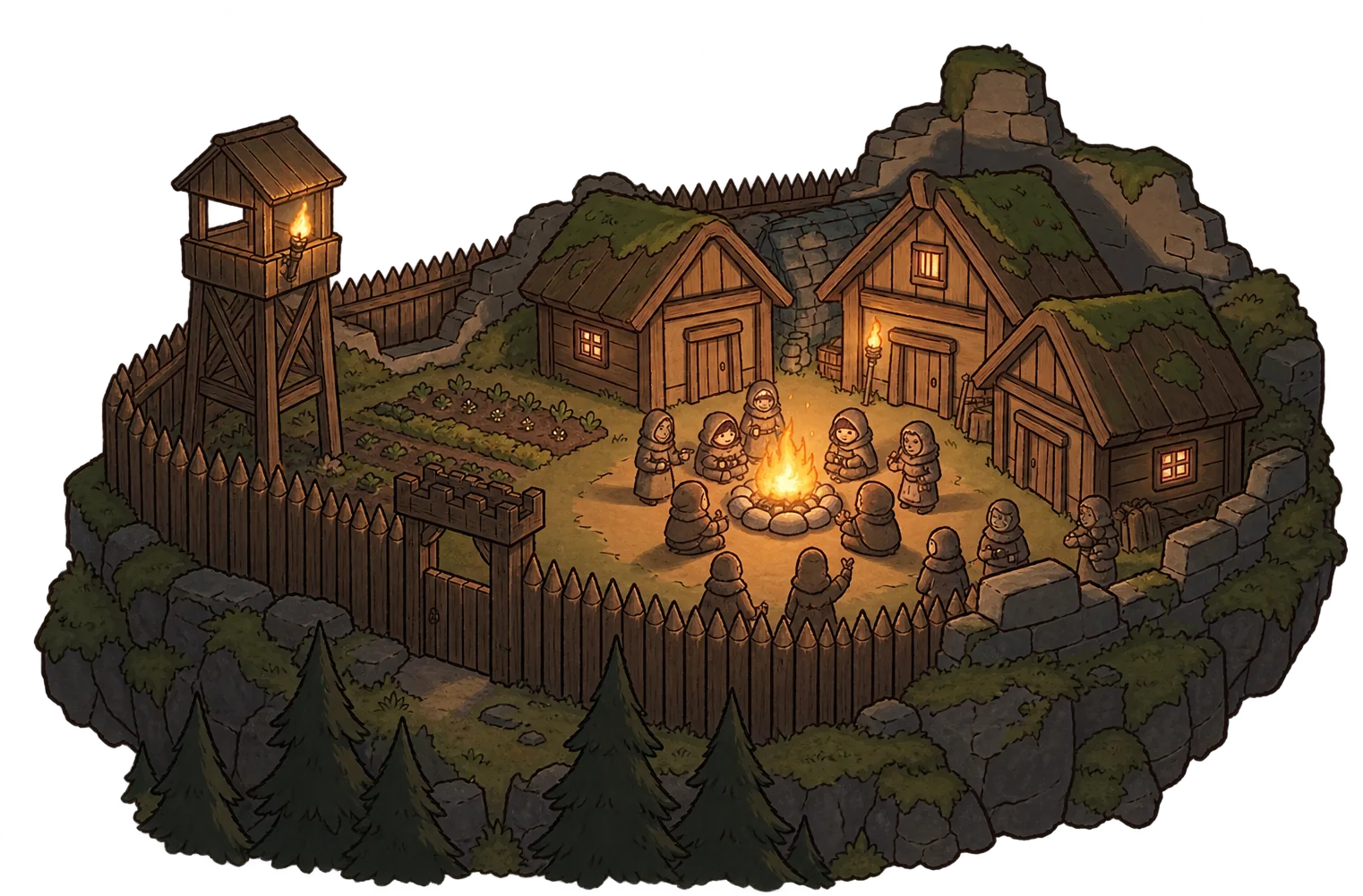
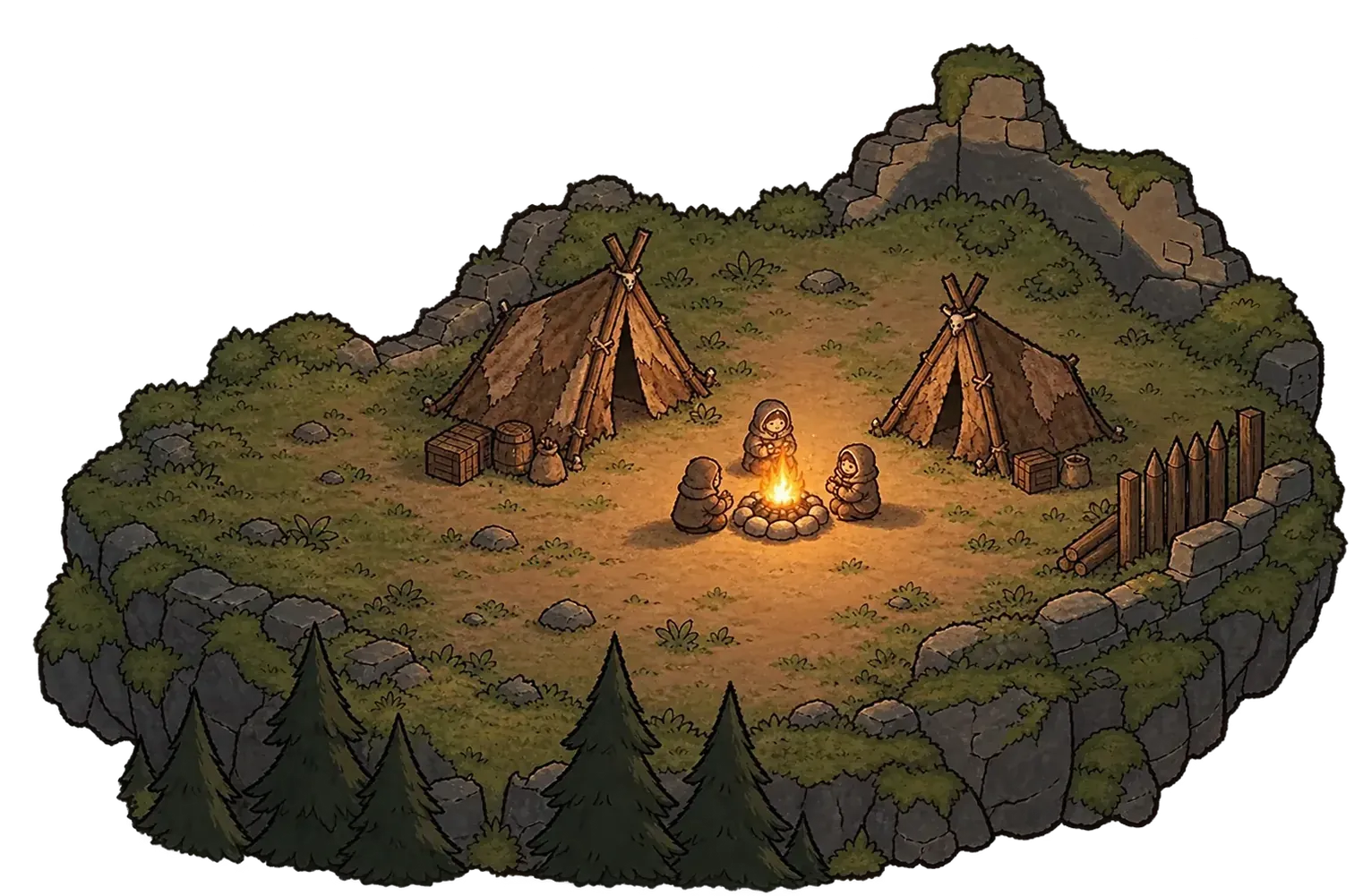
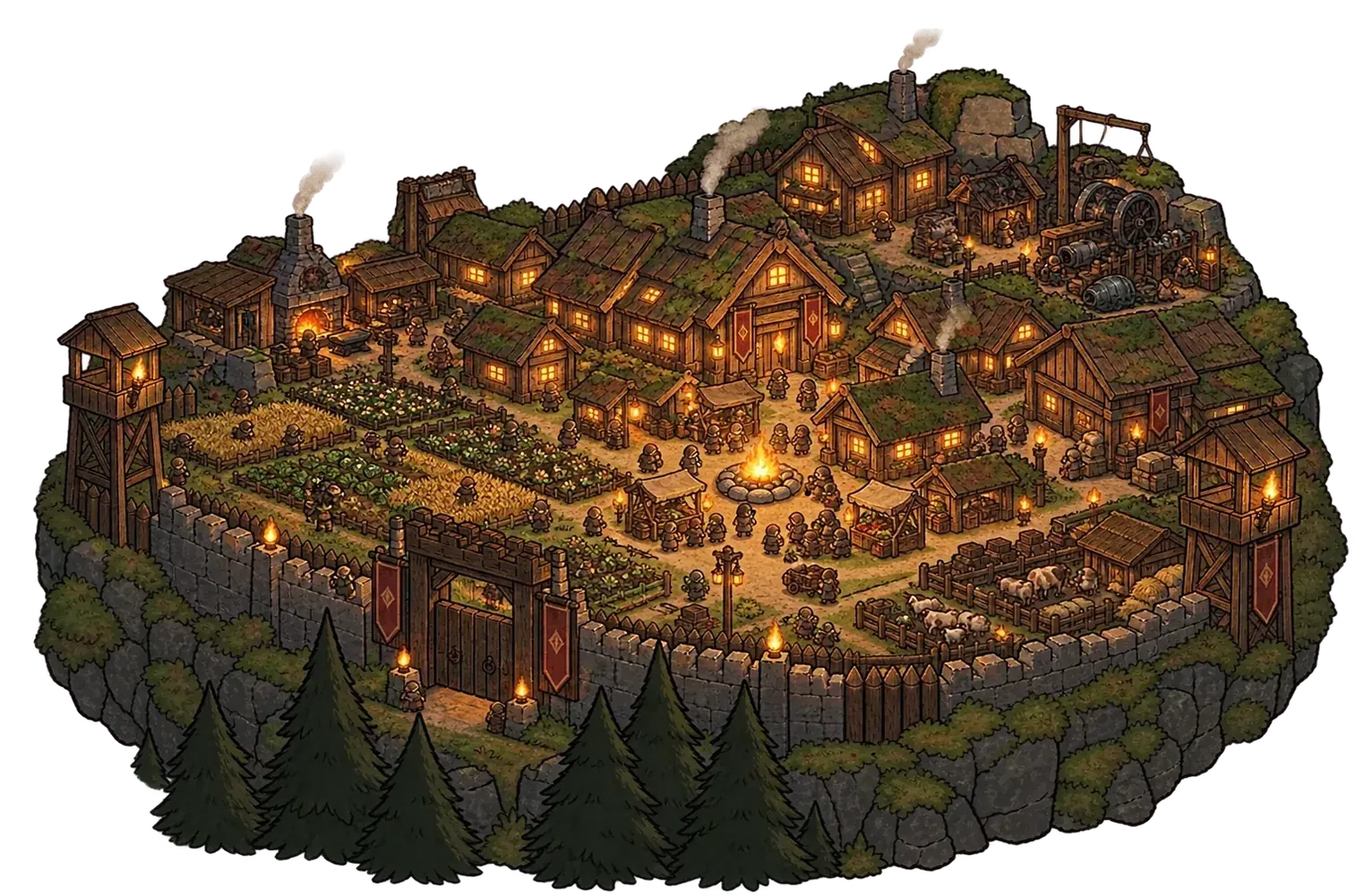
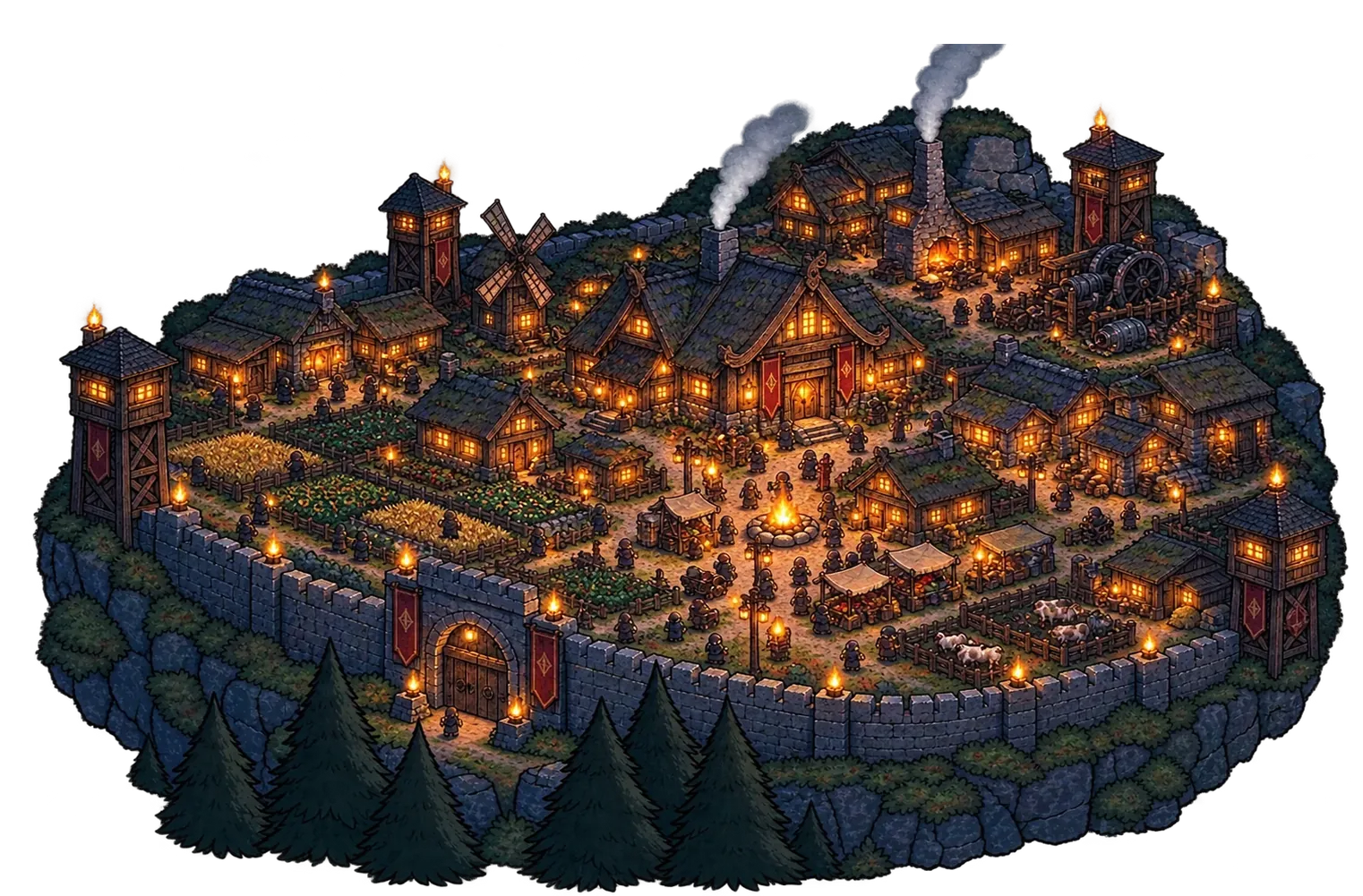
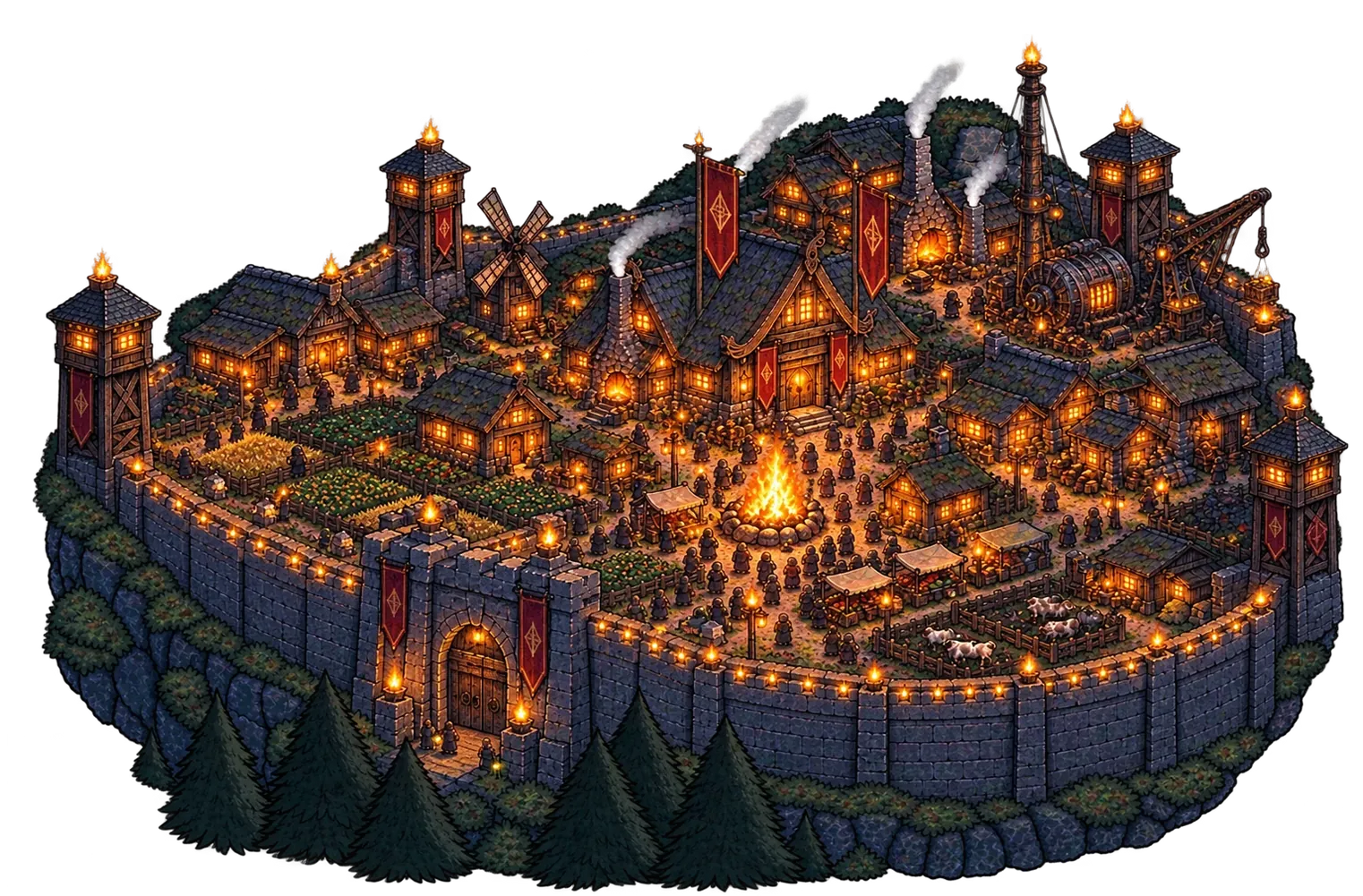
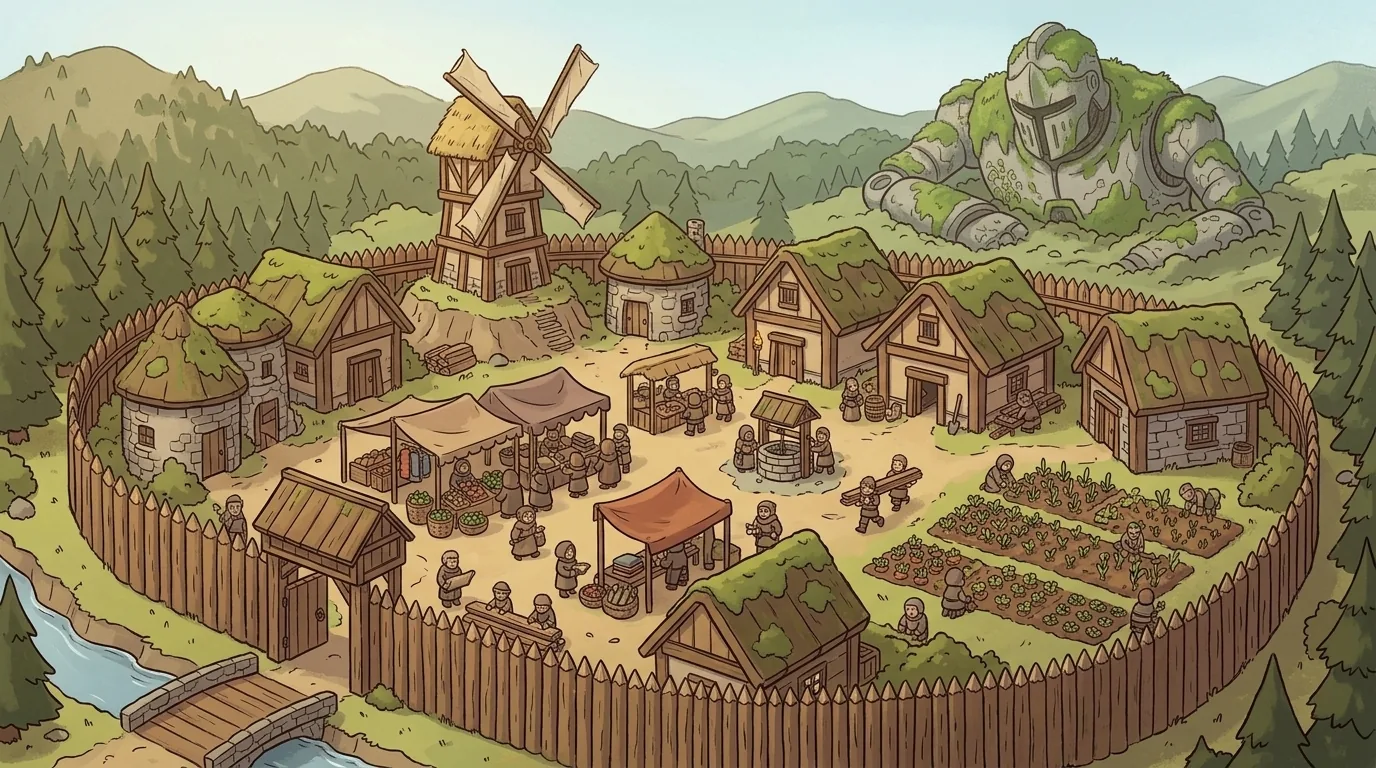
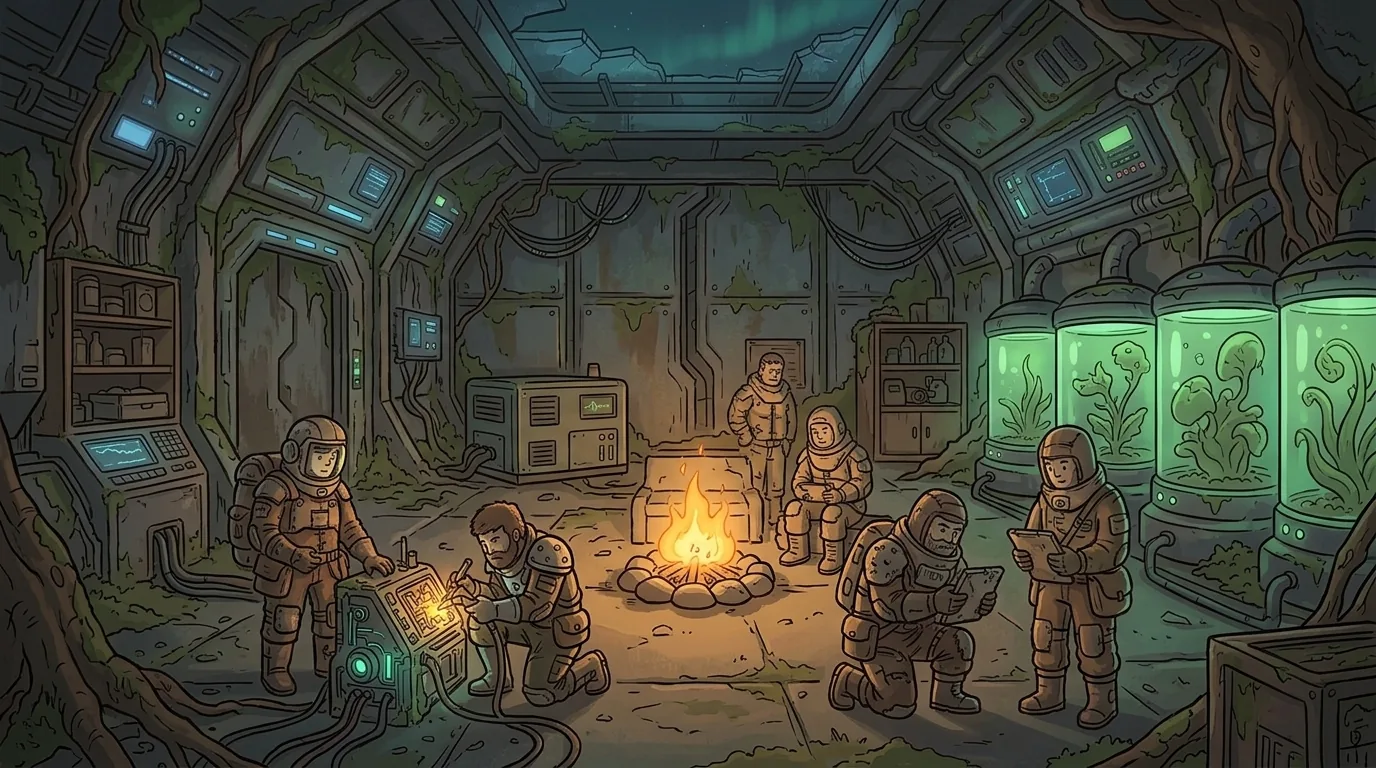
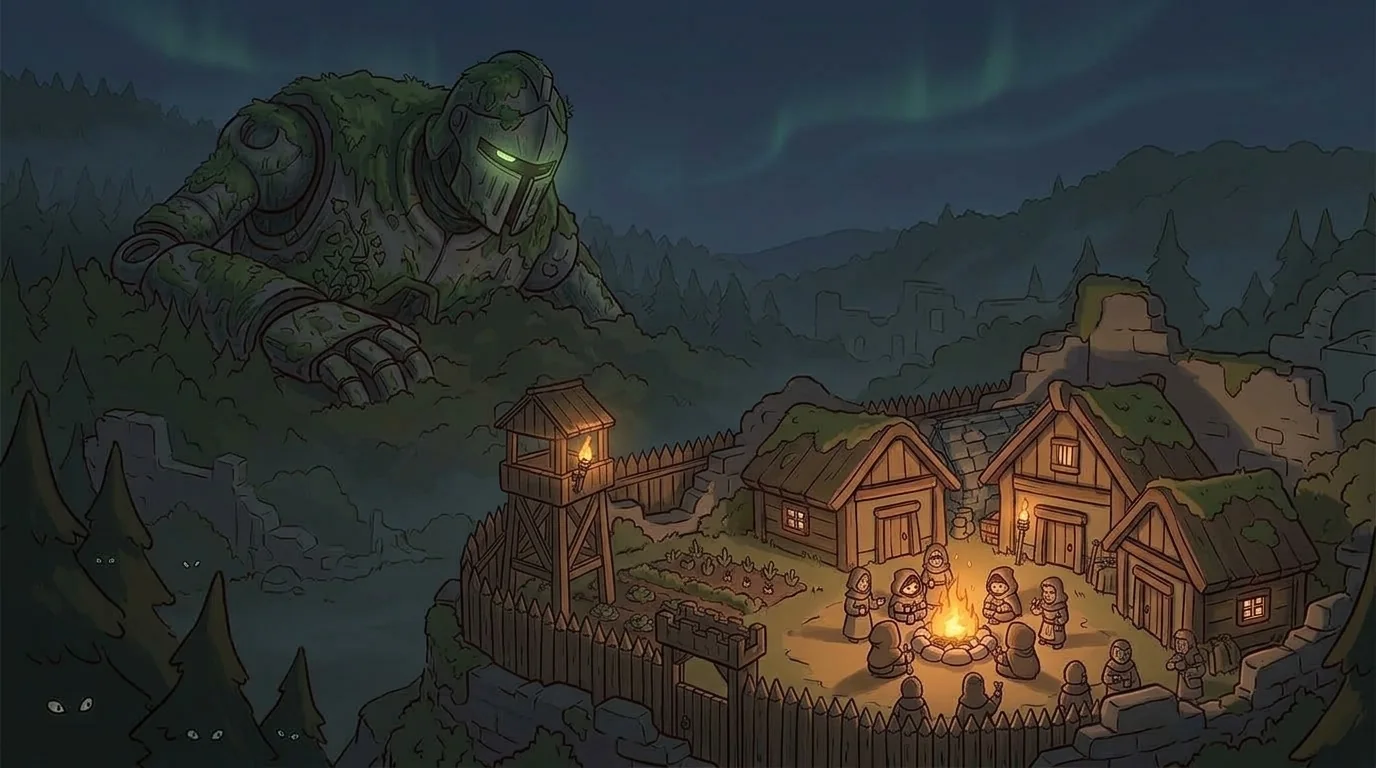
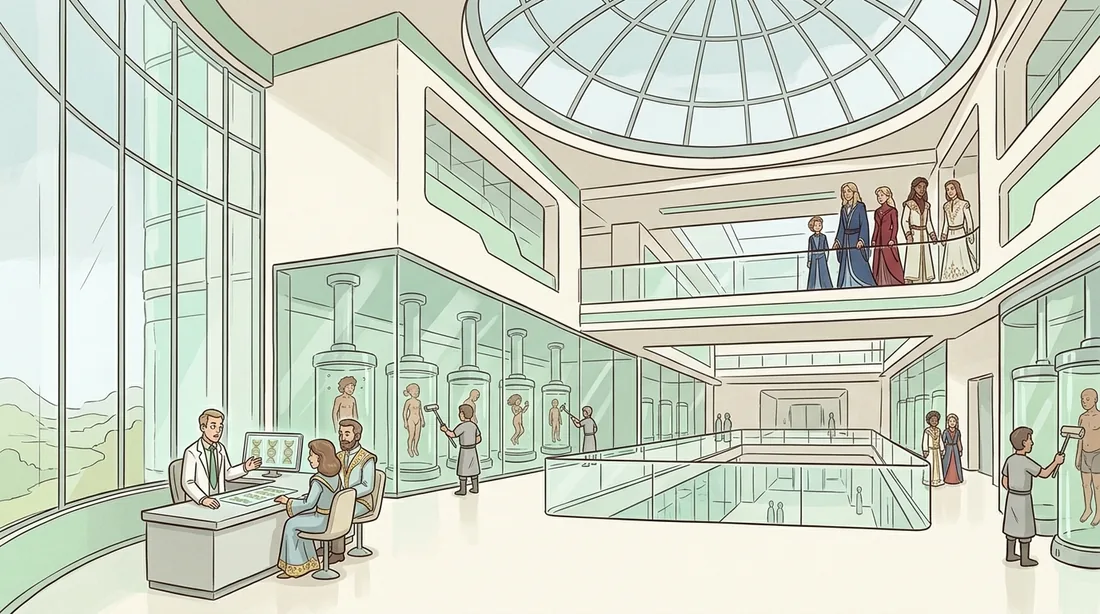
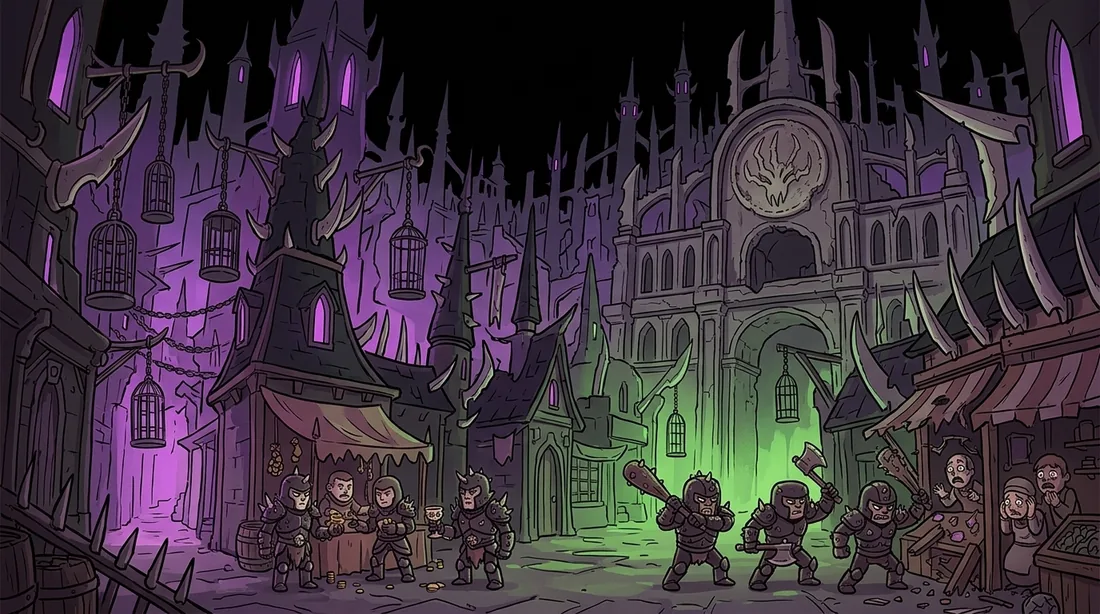
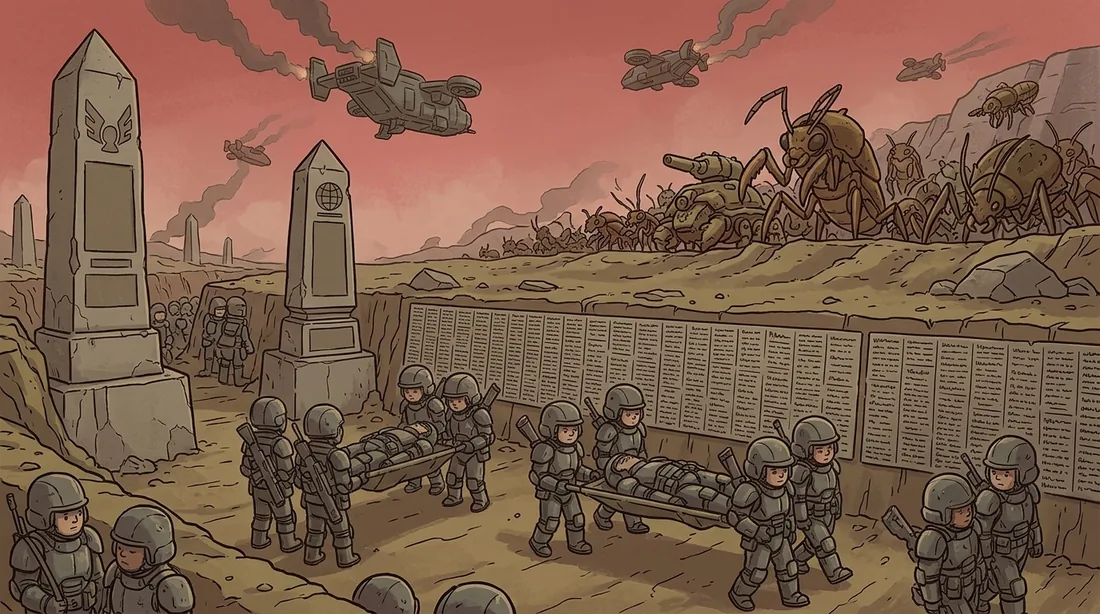
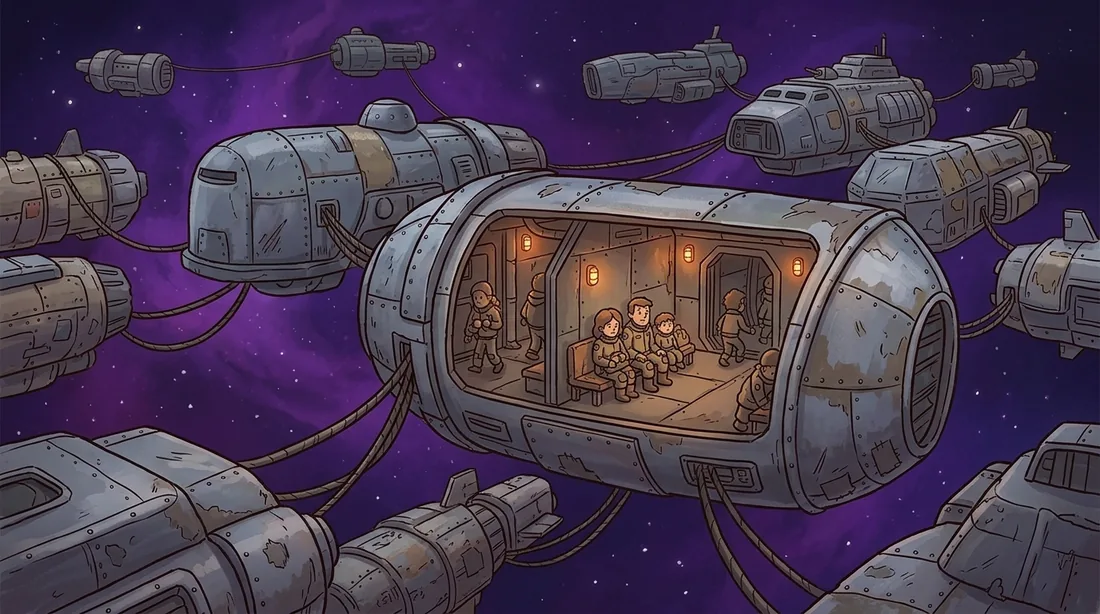
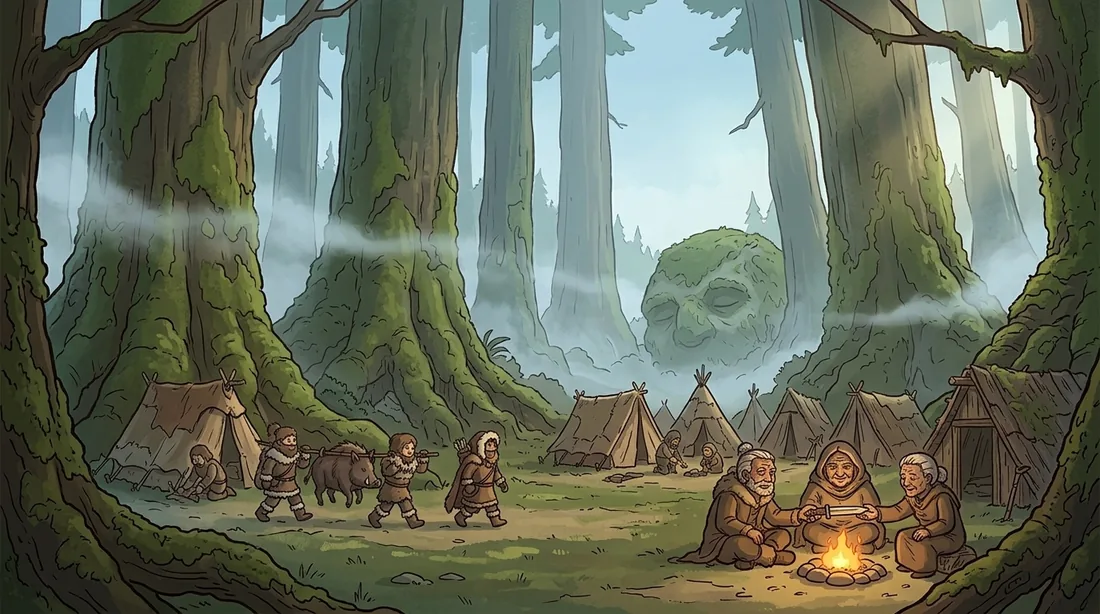
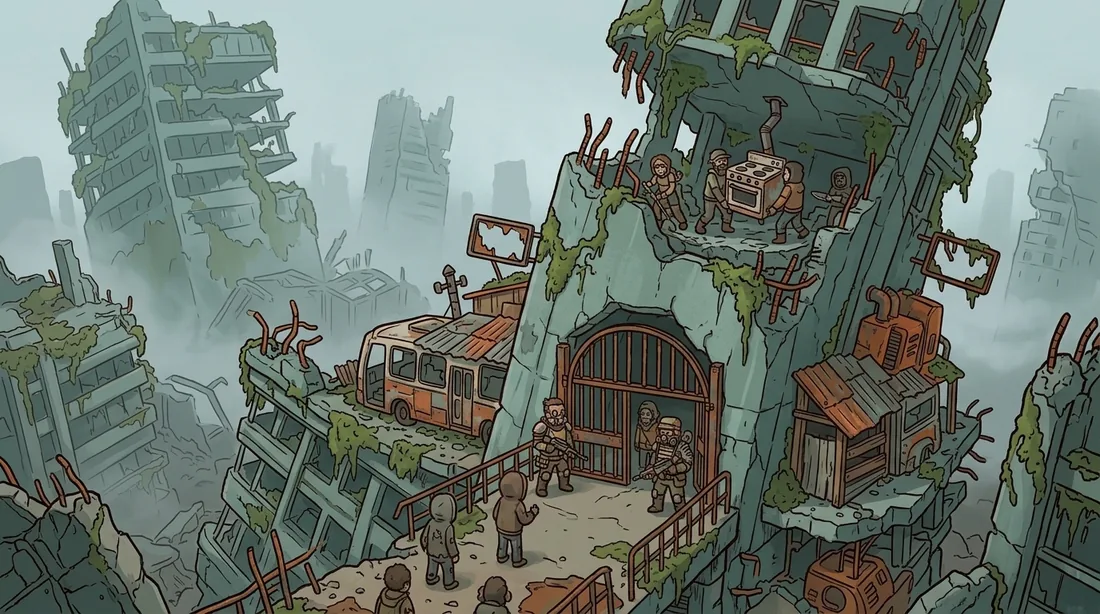
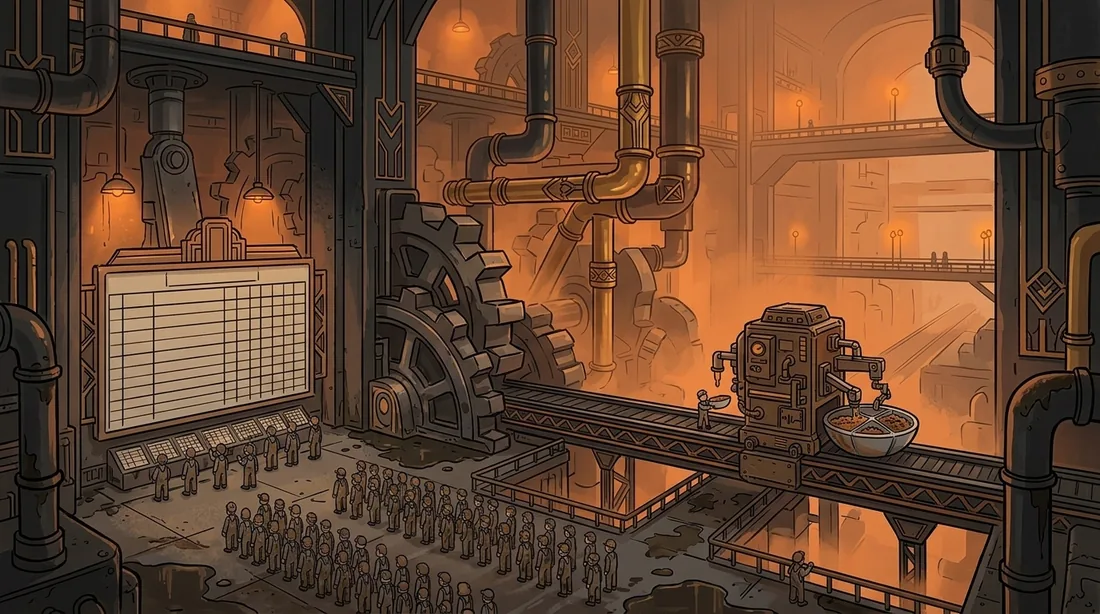
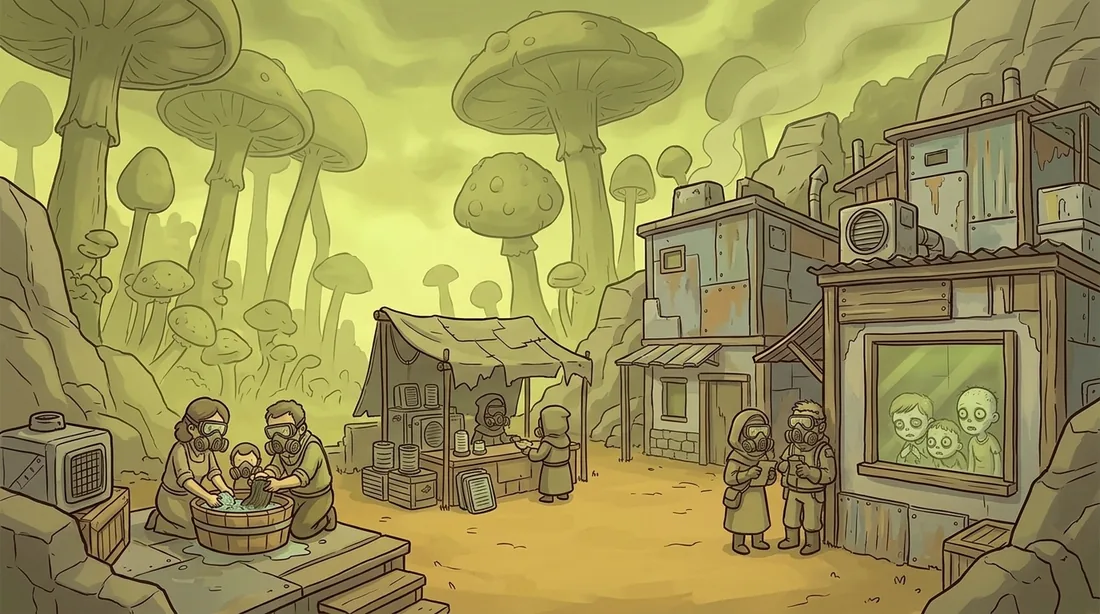
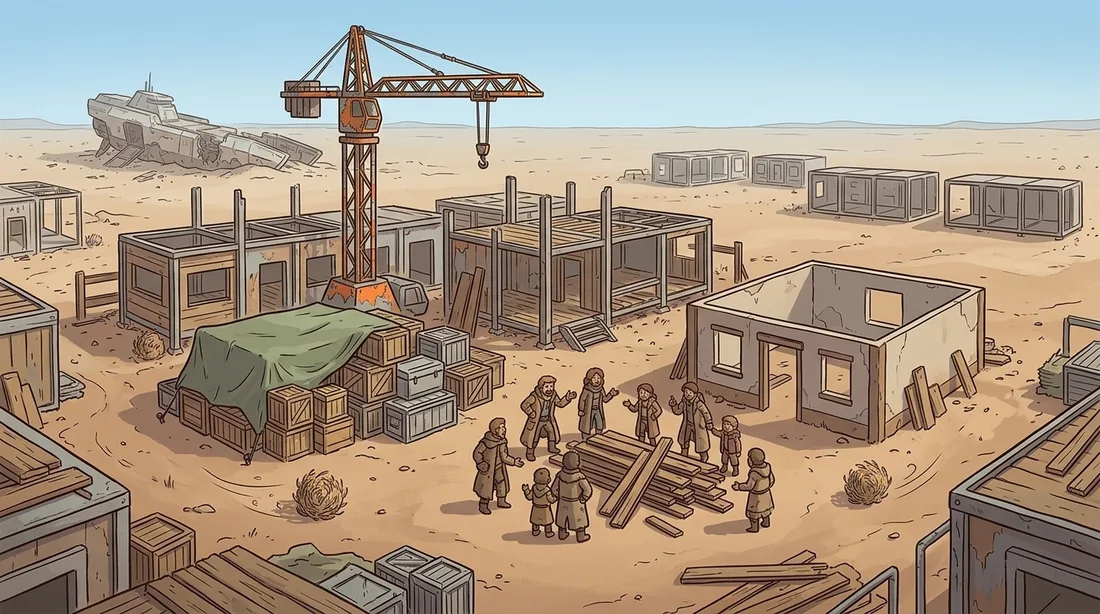
Emberhush is in development, so details may change. All artwork on this page is concept art.
01 · Overview
Onto an unfamiliar planet three people fall
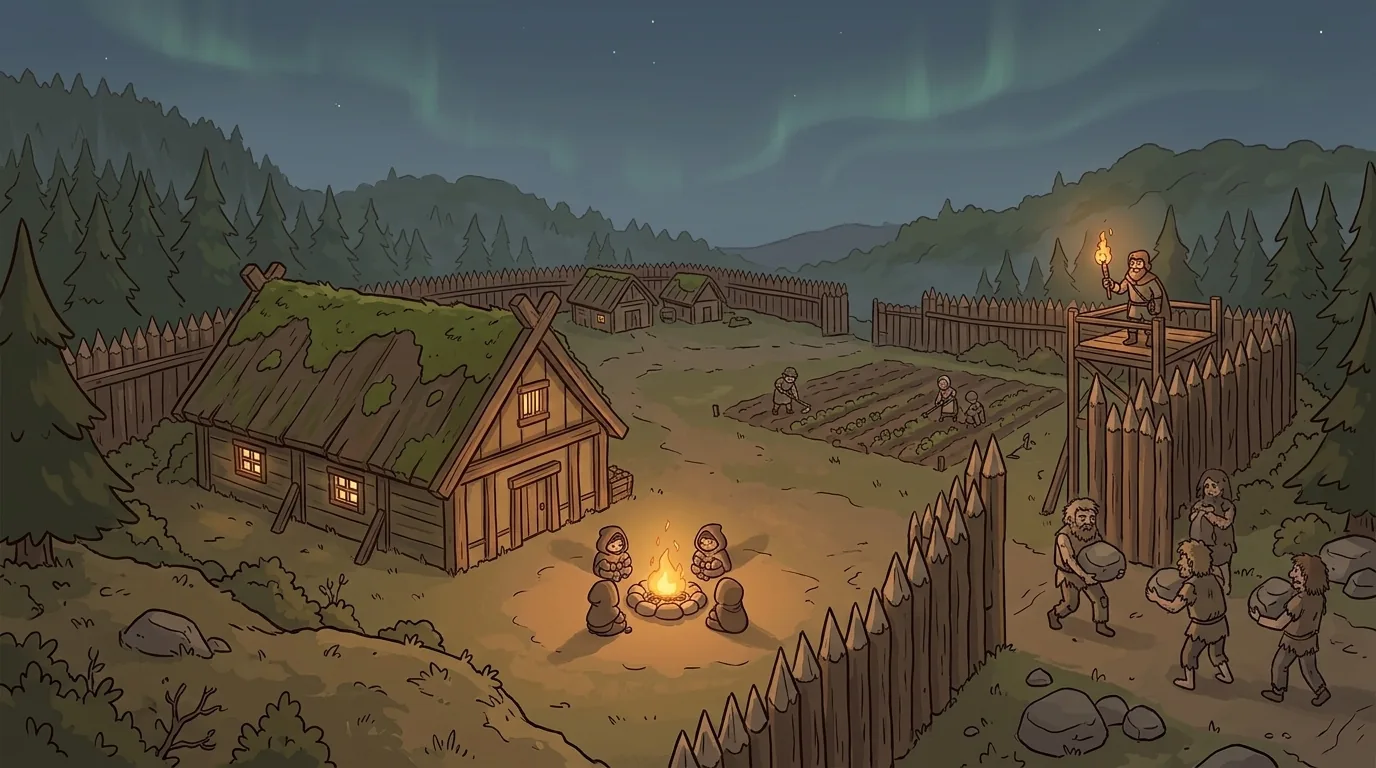
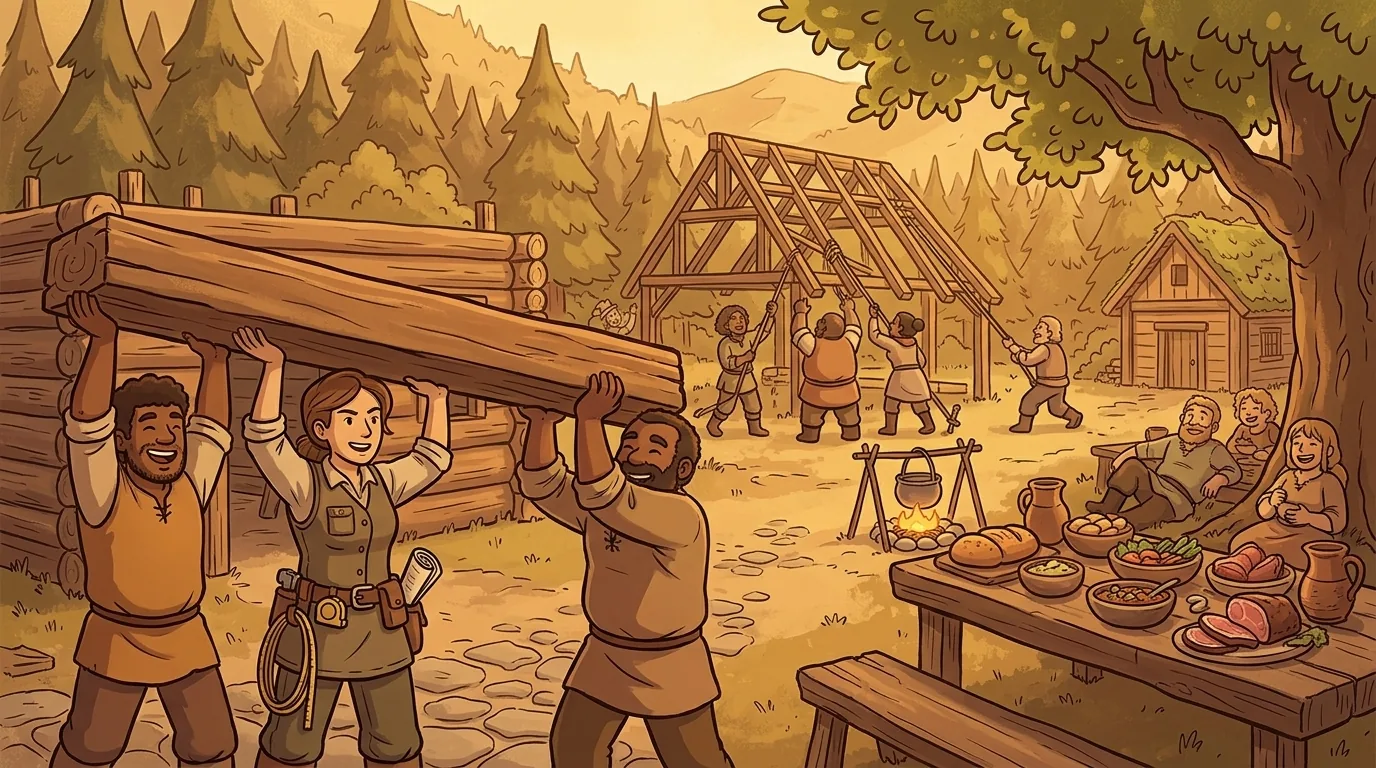
Emberhush is a colony sim. It begins with three people stranded on an unfamiliar planet. On the first day you need a roof against the rain, and on the second you decide who farms and who goes hunting. If you have played the genre before, all of this will feel familiar.
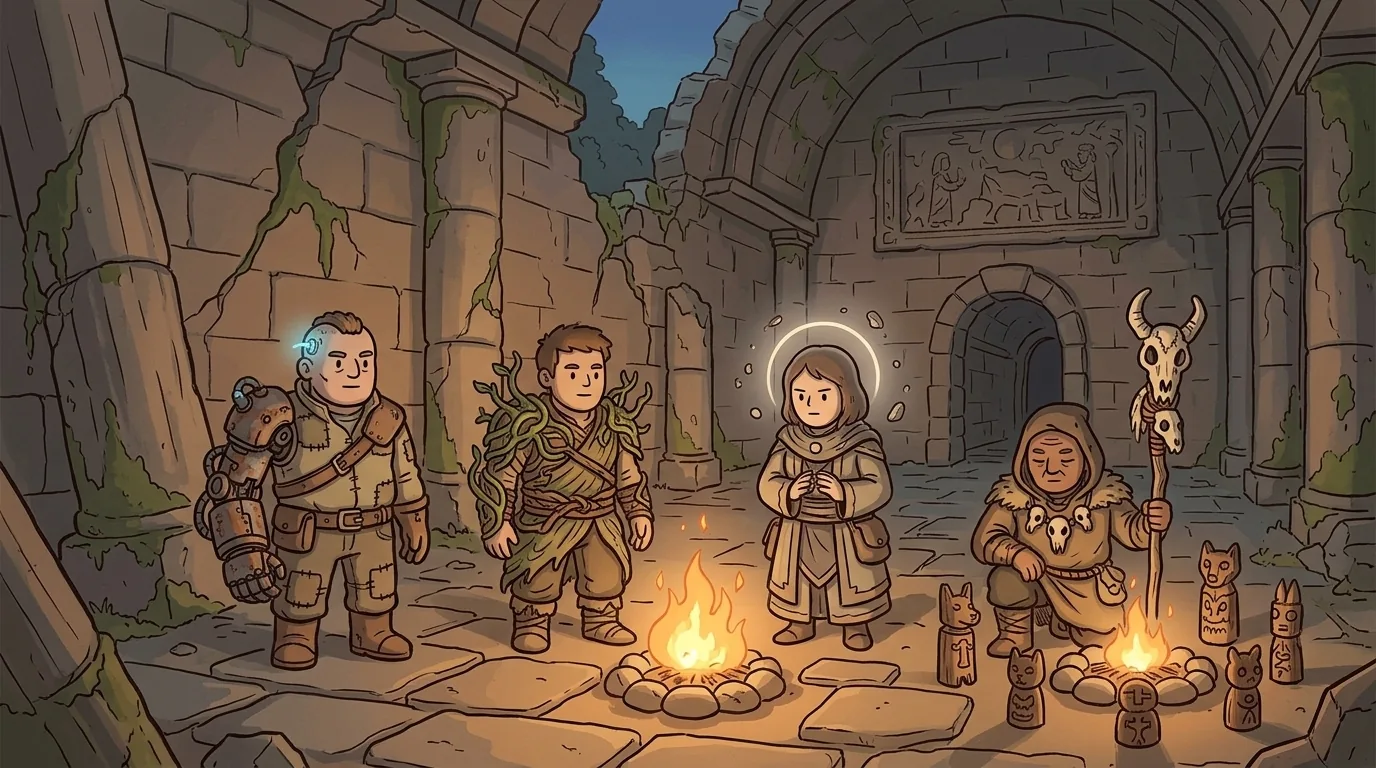
The difference starts after that. Four powers remain in this world: Cybernetics, which remakes the body with machines; Biotech, which shapes life itself; Psionics, which reads the world through the mind; and Shamanism, which trades with the unknown for a price. Which one you pursue changes the shape of your settlement and the lives of the people in it.
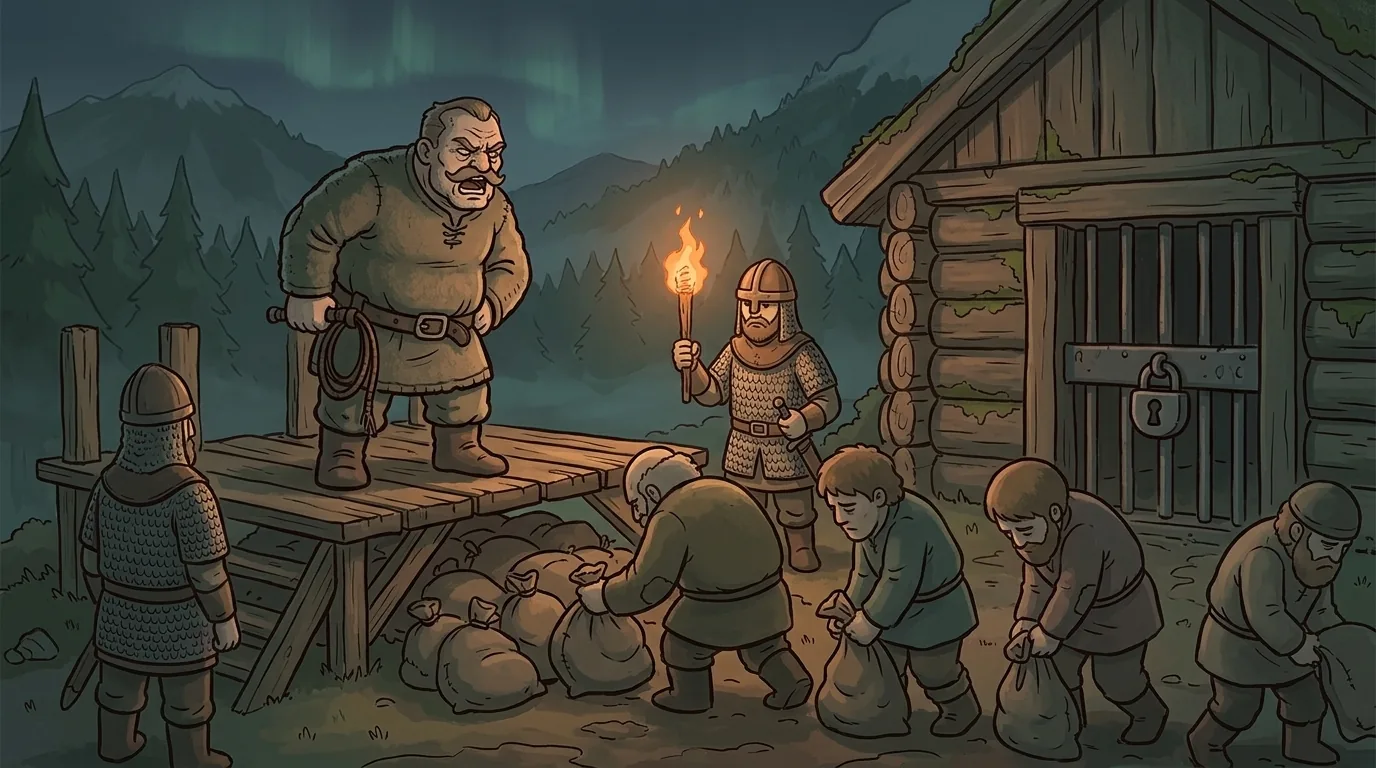
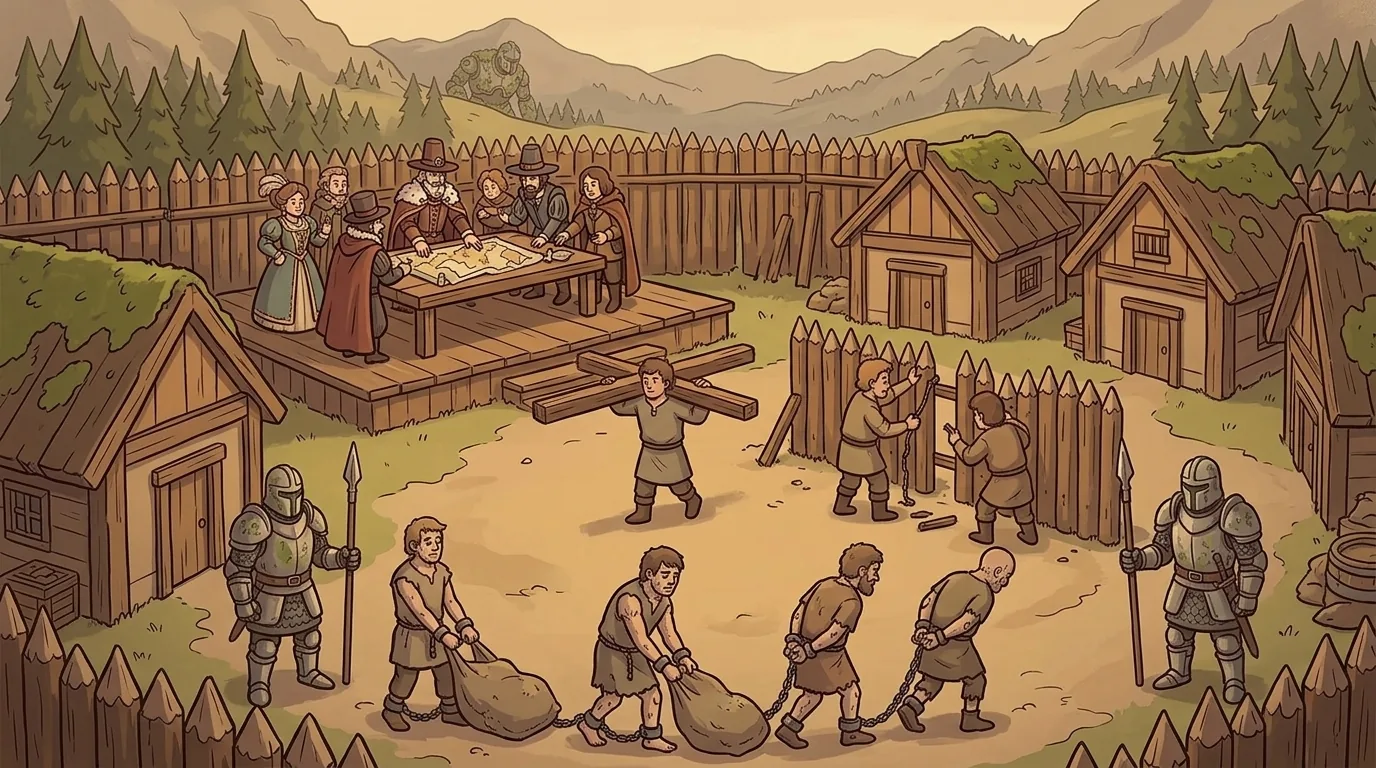
Someone new joins and becomes a citizen, a commoner or a slave. Your settlement might grow into a village that shares everything alike, or one that runs on slave labor to fill its storehouses — the game never says which is right.
And the bigger your settlement grows, the more someone is watching you: machines that slept in the ruins, raiders beyond the stars who caught the scent. In a world where doing well makes you a target, you decide how big to grow.
02 · Governing
Run the groups, raise a few of your own by hand
Once about twenty people gather in your settlement, giving each one orders becomes impossible. So most of them go into groups, and you pick out a few to raise yourself.
Set a daily schedule
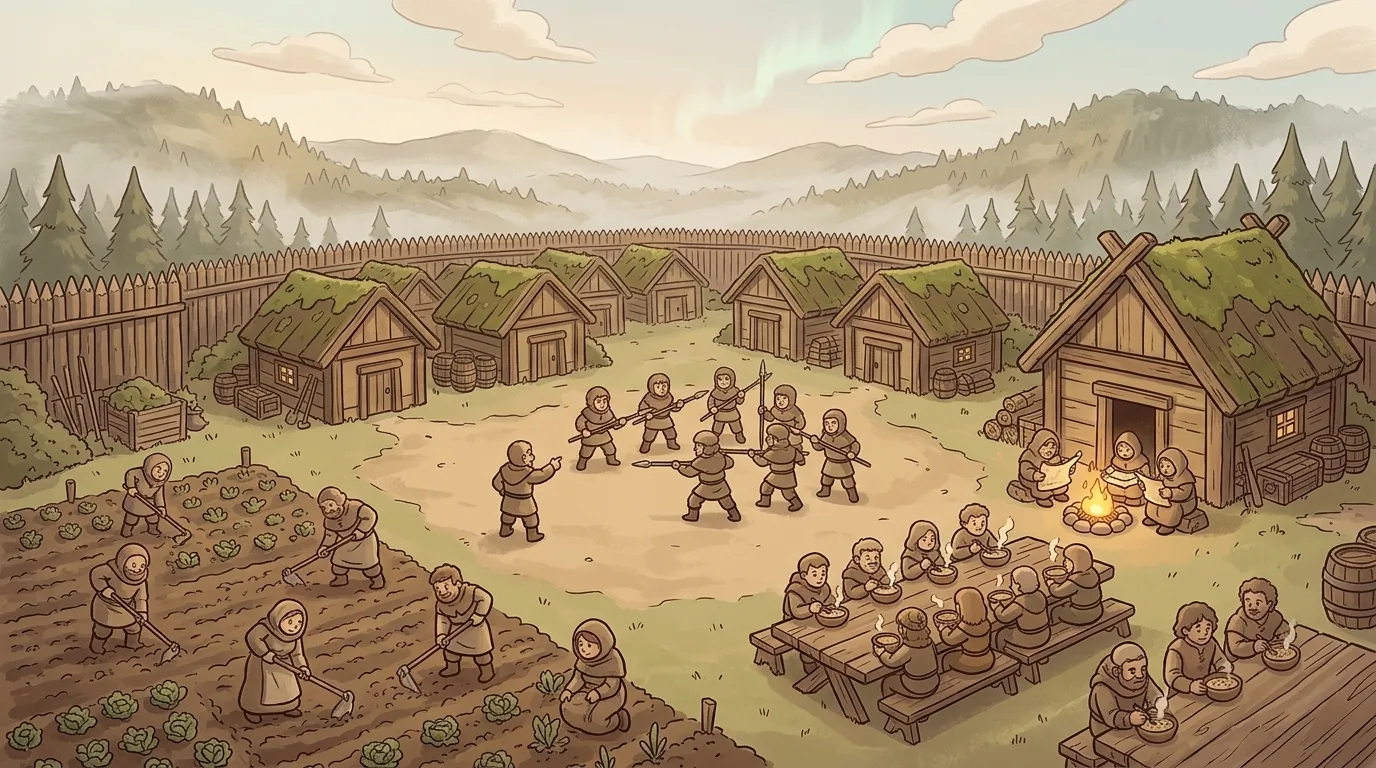
The many whose names you don't know yet are the rank and file. You don't manage them one by one. Put them in a group and they follow that group's schedule. The schedule is split into slots for labor, study, combat drill, rest and meals, and whichever slots you fill most become what that group is good at. A group you keep in drill will be warriors a few months later, and a group you keep in the fields will be farmers. In a pinch, you can hand spears to your field workers. Of course, the fields sit empty in the meantime.
Concept art
Teach a few of them one-on-one
Only a handful of people are ones you actually know by name. For these few, you choose directly what they learn and what they train. Pour their time into study and drill, and the gap between them and everyone else grows wide.
One day, someone from the nameless rank and file catches your eye. Maybe they hauled a water bucket alone on the night of a fire, or held the gate to the end during a raid. From then on, that person has a name. You can even choose the name yourself.
Concept art
Choose a ruling style
Overseers run a group in your place, but you only know them halfway. You know the few you've named inside and out, but you only ever see part of what an overseer is like. You have to decide who gets the post with that much to go on.
You can also choose a ruling style for each group. Rule by fear, and the overseer doesn't need to be especially capable. As long as they're frightening, the work gets done, and treatment costs little. But resentment builds up inside that group. Hand it to a capable overseer and people move on their own, though that takes a good overseer, decent treatment and time.
Rule by fearRule by competence
Assign a class, then promote or demote
When someone new joins the settlement, the first thing you decide is their class: citizen, commoner or slave. It isn't fixed for life. Good work moves them up, and trouble moves them down. Change someone's class and their group changes with it, and a new group means a whole new daily schedule.
Concept art
Things that happened in this settlement
Sunwoo Bokdan
From slave to overseer
Bokdan came in as a slave. A few years later Bokdan became a commoner, and after that an overseer in charge of a group. Of all the groups, it was the very one Bokdan had once been part of. Now, every morning, Bokdan stands before old companions and hands out the day's work.
Skarn Jarndal
An overseer who rules by fear
The moment Skarn took over the group, he cut their treatment. Nobody liked him, but nobody showed up late either. The resentment piled up inside the group. But output stayed good, so you end up leaving Skarn where he is.
Seria Halstead
Taken off work and put into drill
Seria worked fast and handled the storehouse work almost single-handedly. You took the storehouse work out of Seria's day and left only combat drill. That year the storehouse was noticeably emptier. On the night raiders came over the wall, no one weighed the loss.
Semud Korrashi
From the rank and file, named one day
You didn't know who came running with a water bucket when the fire broke out. Until then, they were just one more head in the count. The next day you asked their name, and from that day on, Semud has been called by it. You still don't know if Semud was really the only one who moved that night.
03 · The four powers
Four powers, each comes at a different price
Concept art
Cybernetics
The power to build and repair the body and gear with machines
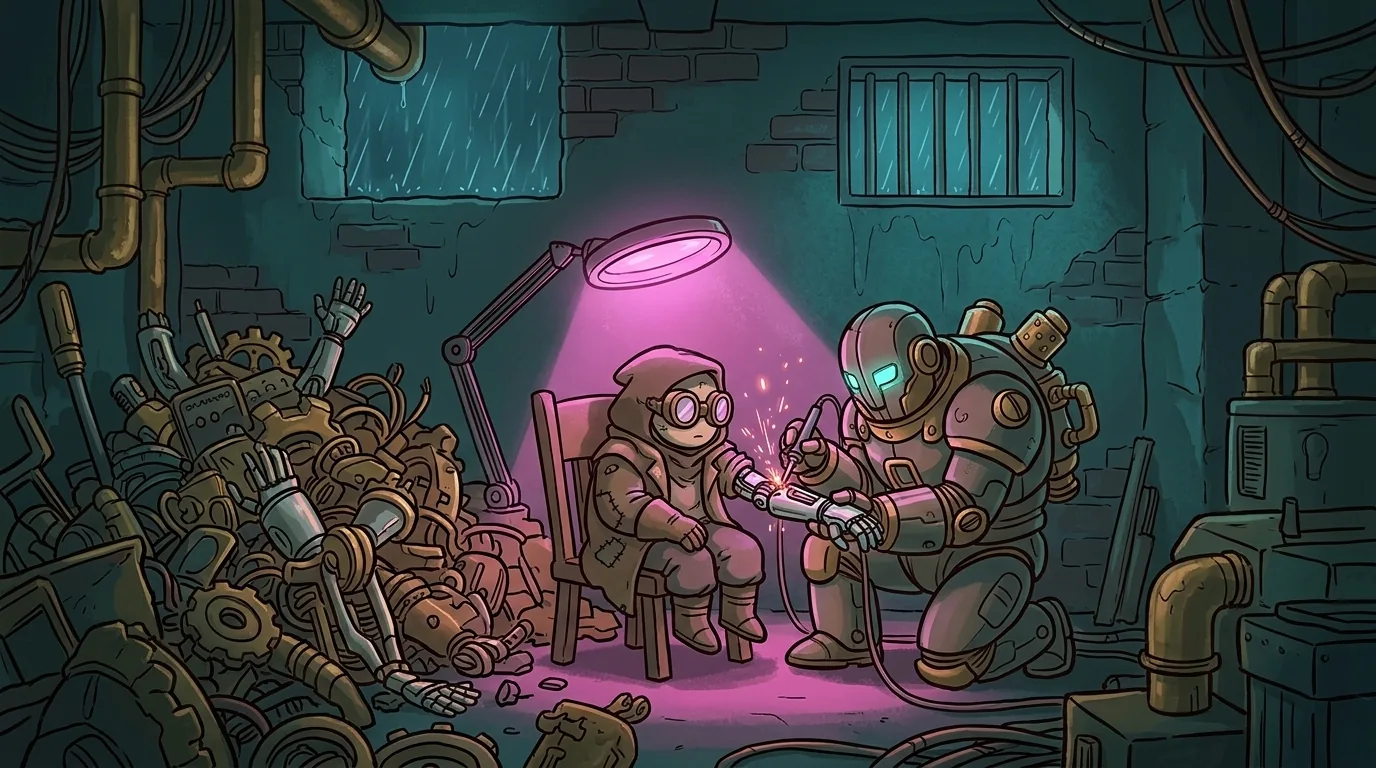
You pull parts scavenged from the ruins apart, and carve the ones you are missing by hand. That is how an arm becomes chrome, and an eye becomes a lens. The price is money, and a little of your humanity. The money, at least, you can always earn back.
A chrome forearm splits open and a missile streaks out, and the rock a raider was hiding behind goes with it. Build a machine that moves on its own, and it will head out to the ruins for parts even while your workers sleep. Machines outlast the people who built them, which makes this the power that lasts the longest of the four.
Get good enough, and you can build a war machine a person can climb into. One settler in the cockpit can clear out an entire raider pack right at your gates.
Concept art
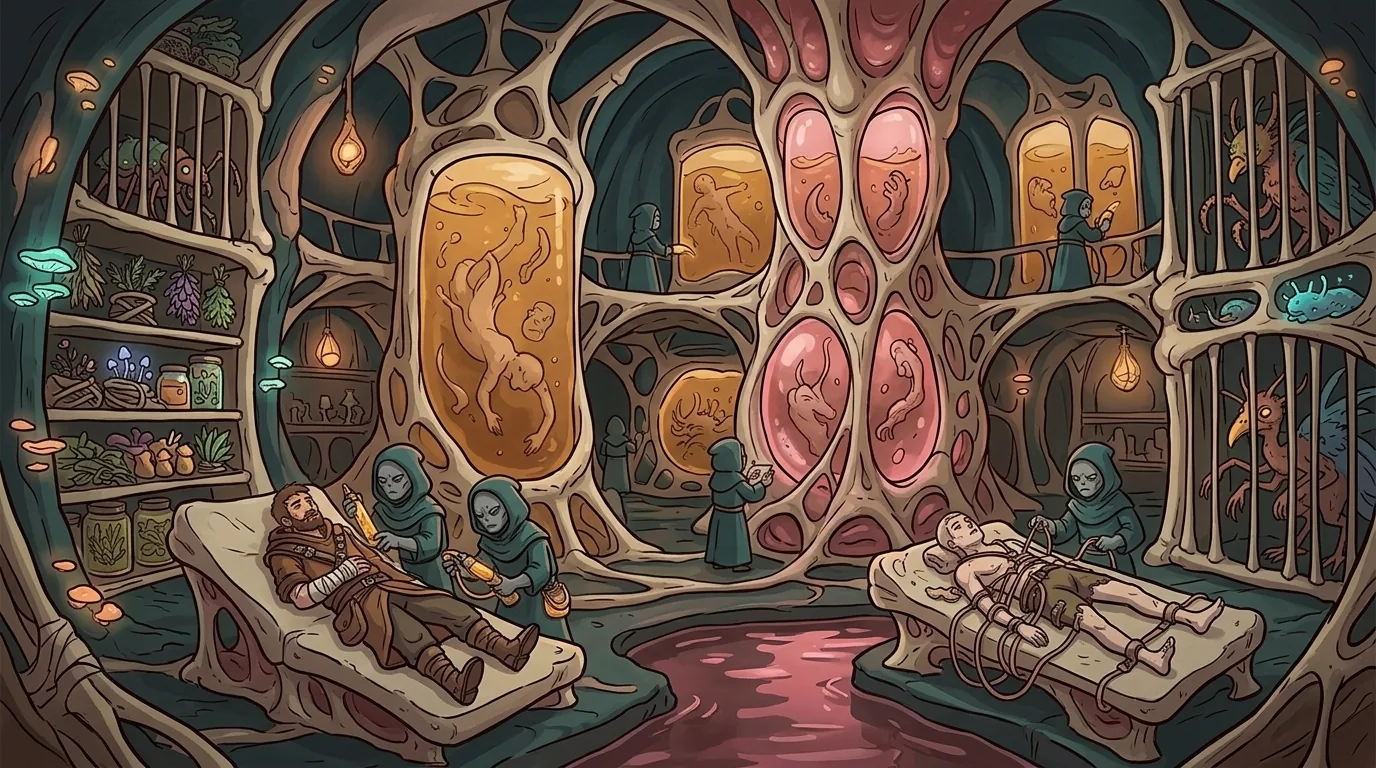
Biotech
The power that uses life as raw material
You lay a living person on the table and rework their body, and grow new life in vats. The price is paid with someone's body, usually the person in the next bed, or the next generation. The one who ordered the experiment rarely pays it. Except in the year a disease gets loose and empties the whole settlement in a single season.
When a fight breaks out, you open the cage on whatever you have been growing. It bursts out, bites the lead raider clean through the shield, and hurls them over the wall, and the rest of the pack scatters on its own. The wounded get stitched back up, and modified seed and livestock keep the storehouse full.
Push it far enough, and you shape a child's height, strength, even the diseases they will resist, before they are even born. Grown, that child becomes a warrior who can catch a raider's axe out of the air, bare-handed.
Concept art
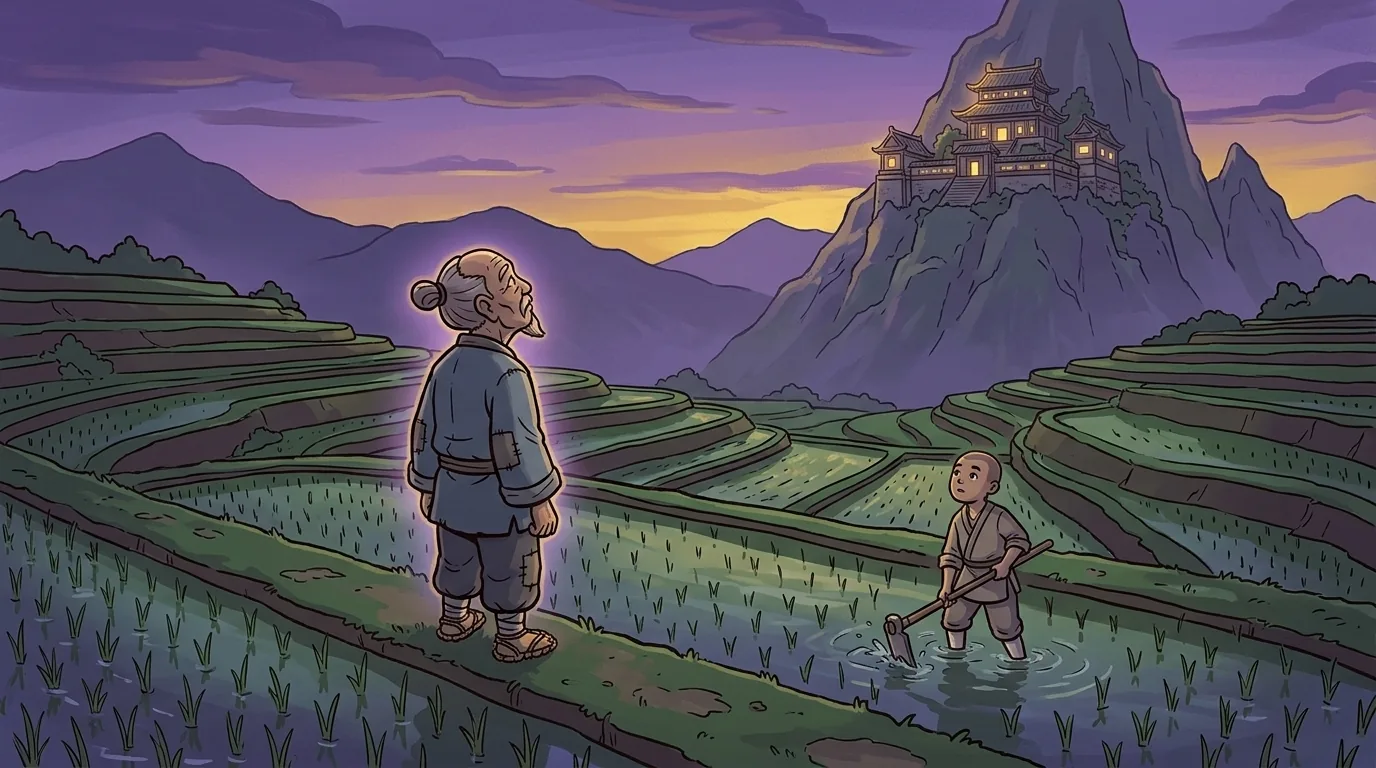
Psionics
The power to read the world with the mind
An old man tending the field sets down his hoe and looks up. He has just seen something that has not happened yet. The price is years. Even this old man never once showed his face in the fields when he was young, too busy sitting and training since childhood.
Before an opponent can even move a foot, the old man's blade is already at their throat. Against someone with a gun, he walks straight in, batting the bullets aside as they come. On days without a fight, he reads what is on someone's mind before they open their mouth, and catches every lie on the spot.
Someone who has trained long enough sees which mountain pass the raiders will cross before they do. By the time the pack reaches the ridge, an old man with a sword is already there, waiting.
Concept art
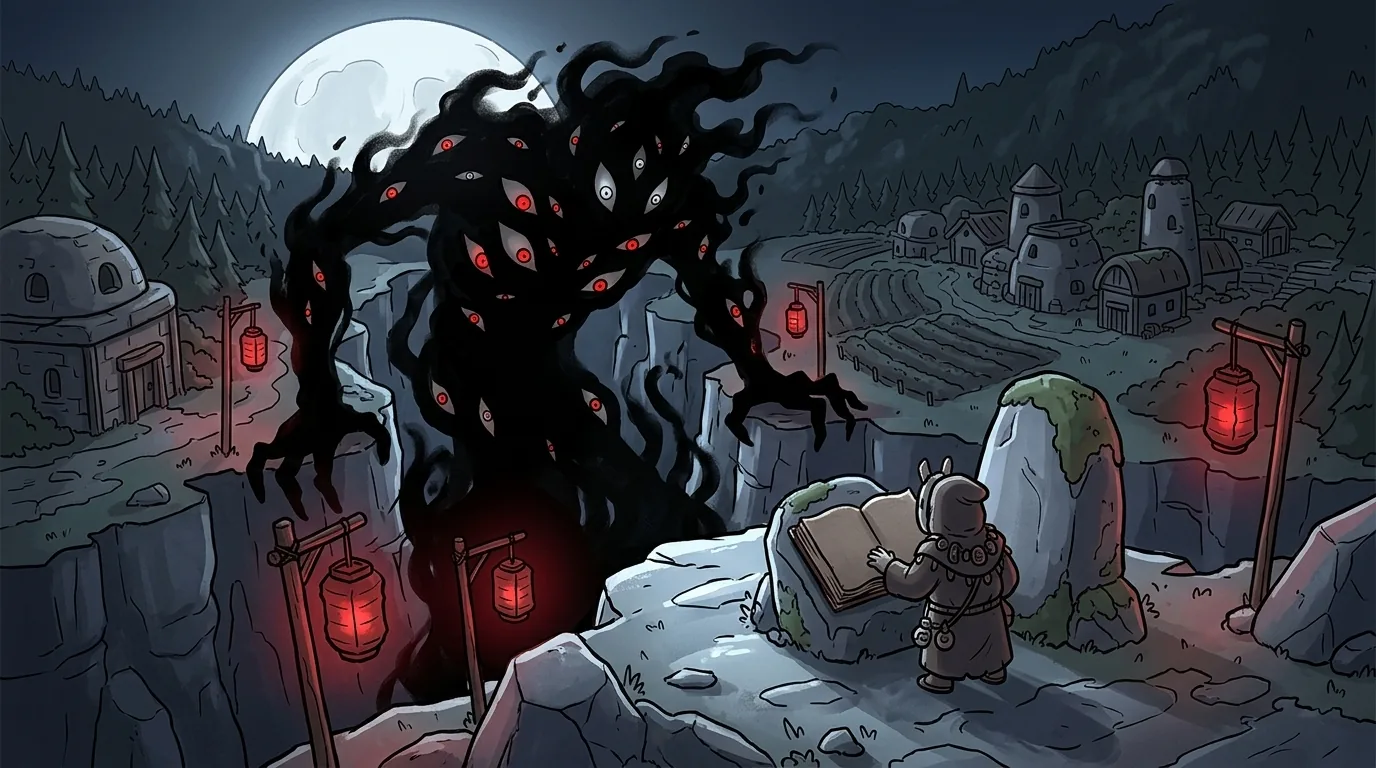
Shamanism
The power that bargains with what you cannot see
A shaman goes out at midnight and comes back from a bargain with something unseen. Whatever was wanted, they got, and the price has not been paid yet. So far, that sounds like a good deal. But a debt put off does not disappear, and the next one called to the front might be someone you love.
When a bargain lands, a raider pack loses its way on a perfectly clear road, circling the same hill until sundown. Any leader who still makes it through falls to a curse before ever swinging a blade. Shamans can also stop a plague, or call rain down on the settlement's fields.
You can even summon something that has been drifting through the forest and bring it onto your side. When raiders climb the wall at night, it drags them into the dark one by one before a sentry ever has to move.
04 · Starting eras
Choose what you hold when you begin
You can start with nothing but stone and bone, in a village where people already live together, or with equipment an old civilization left behind.
Concept art
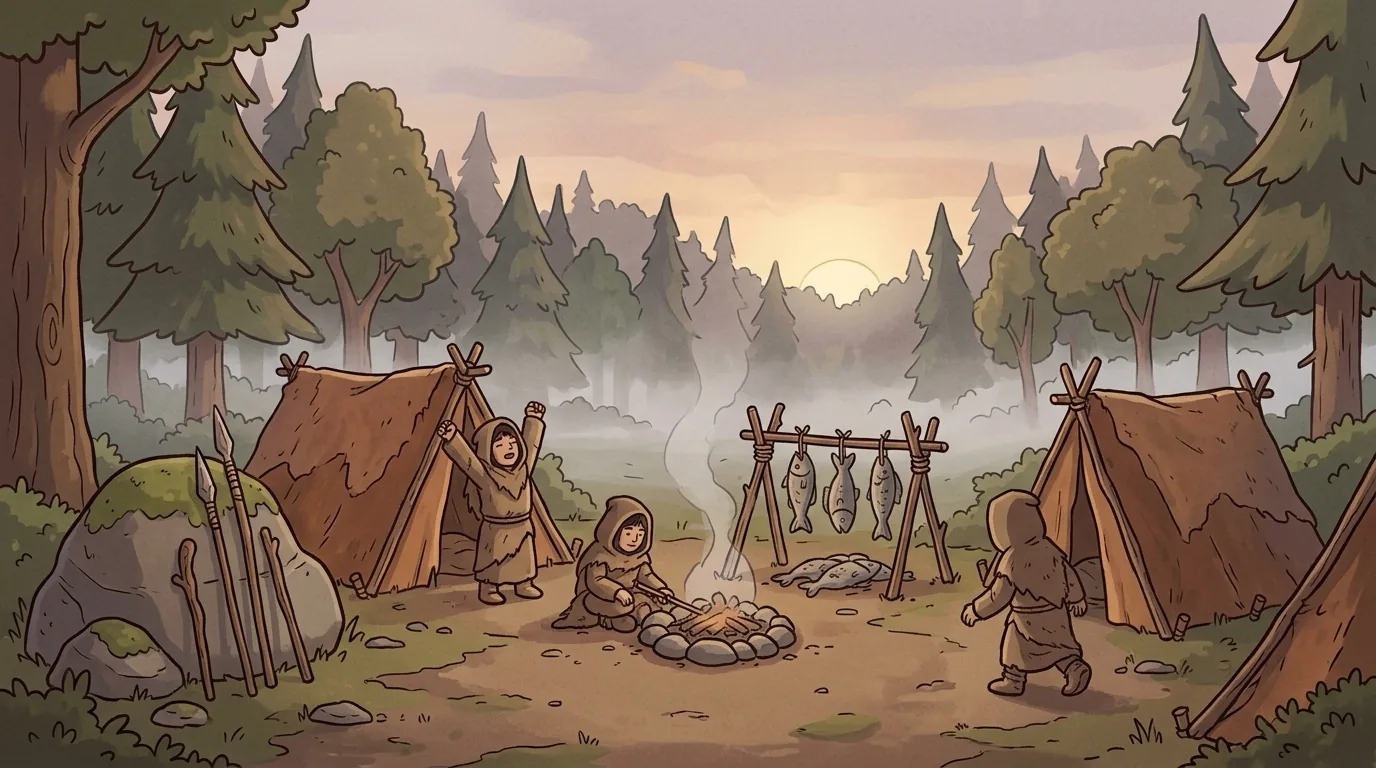
Era 01Primitive Tribe
You start with stone and bone. For a while, the only things you face are hunger and the neighboring tribe. There are no machines at all, but Shamanism and Psionics are already in use.
Concept art
Era 02Thriving Settlement
You start in a village where many people already live together. They know how to work iron and till fields. Here the rules between people cause more trouble than hunger, and the ones who attack aren't beasts but lords and bandits.
Concept art
Era 03High-Tech Remnants
You start out using machines an old civilization left behind. But you don't know how to make them. As the remaining parts dwindle one by one, you have to work out how they're made all over again.
05 · Goal
The more you settle in, the more eyes turn your way
A settlement starts with just a handful of people. Raise houses, clear more fields, and raiders from beyond the stars start showing up one by one. In the end, they all come at once. Turn back that final assault, and you can leave this planet behind for the space beyond.
06 · Settlers
Everyone who arrives left a home behind
These are the sixteen homes the settlers left behind, and sixteen societies your own settlement could come to resemble. Some fill their storehouses with slave labor; in others, the company makes the laws and runs the hospitals. Which one it grows toward depends on how it is ruled.
HomeNatural Planet·Former work Hunter·Why they left Beast attacks
Concept art
Tairo was a hunter who rode a long-antlered red deer along the forest edge, bringing down supper with stone-tipped arrows.
The village owned exactly one metal knife. It made the rounds from house to house every month, and whenever it was his turn, he would sharpen it, too precious to use up, and hand it back.
Winter was the hungry season, and in years when the hunting ran short, the old set down their bowls first. One autumn, a boar bigger than a cart came down out of the forest.
A shard of metal was lodged in its side, the flesh around it black and rotting, and even shot full of arrows it plowed straight through fields and fences. After that, more and more animals came out of the forest every year.
Even now, in the settlement, whenever Tairo borrows a knife, he sharpens it before he gives it back.
Namgung Deoksu
HomeRuins Planet·Former work Junk dealer·Why they left Relic rumors
Concept art
When a rusty cart rattled through the alleys of the collapsed apartments, people knew the junk dealer Deoksu had come.
Break through one wall and you would find someone's kitchen from a hundred years back, and Deoksu loaded pots and cans from it onto his cart. The owners had been dead for ages, so there was no reason to hesitate.
Anything worth having was in the districts where the support beams still held, and a gang blocking the way in took half a cartload just to let him through. Then a rumor started going around the market.
Somewhere far underground, they said, there was a round steel door stamped with a huge number, sealed shut for a hundred years. Deoksu sold his cart to buy a map to it.
Even now, Deoksu cannot look at a wall without knocking on it, listening for a hollow spot.
Marensa Ashford
HomeFactory Planet·Former work Supervisor·Why they left District closure
Concept art
Supervisor Marensa stood on a walkway above gears the size of houses, watching to see who pulled their lever in time with the giant clock hands.
Whenever a slot on the duty roster went empty, the management machine cut that day's rations. Marensa made a habit of finding the empty slots before the machine did and filling them in with names.
Plenty of people could not stop their hands from turning screws even after their shift ended. Marensa was the one who pressed a food tray into hands like that.
Then, one day, there were no more names left to fill the roster. When the management machine locked the district gates from outside and cut the lights, Marensa led the last shift out through the elevator.
Even now, whenever a notice goes up on a settlement wall, Marensa checks for empty slots first.
Kasir Hazmal
HomeToxic Planet·Former work Quarantine officer·Why they left Contamination
Concept art
Quarantine officer Kasir's job was to stop anyone arriving through the spore fog at the gate, and listen to their breathing before the mask ever came off.
On that planet, nothing cost more than a mask filter. Families who could not afford new ones washed and reused the old, and their children were always the first to start coughing.
Anyone whose breath rattled was turned away, no matter how their family begged. A single handful of spores could turn a grain store into a forest of white mold.
Then the well water began to smell of mold, and soft fuzz crept over the ceiling beams. Kasir sold everything to buy one filter per family member and left the planet. Even in the settlement, Kasir still sleeps with a mask hanging around the neck.
Ashild Jenberg
HomeFrontier Planet·Former work Surveyor·Why they left Contract expired
Concept art
Ashild was a surveyor who rode on horseback across the dusty plains, driving stakes and stringing lines to mark the boundaries of land.
The homeworld dropped the settlers off and went silent. Rusted cranes stood frozen beside half-built buildings, and children tied ropes to their arms and swung on them.
Whenever Ashild drove a stake into disputed land, people from both families showed up with guns on their hips to watch. The contract said the land was theirs if they worked until the deadline.
On the day the deadline came, the administrator handed the paper back, saying there was no homeworld left to stamp it. Even after coming to the settlement, Ashild still counts out distances in footsteps while walking.
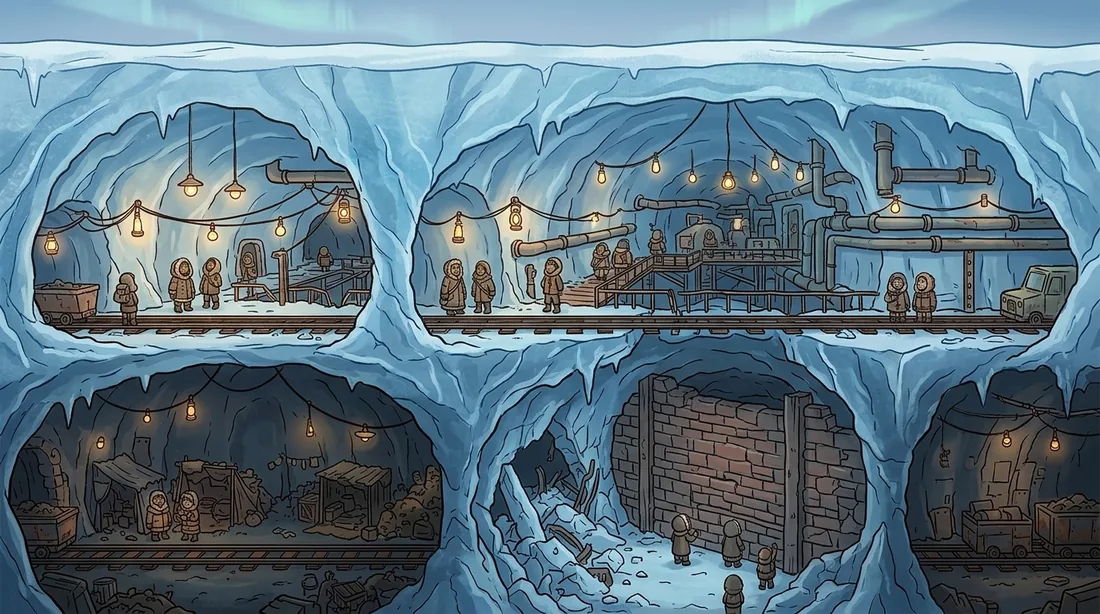
Begut was a pipefitter who rode a hand-pumped rail cart through tunnels beneath the ice, sealing pipes wherever they leaked.
Air and water always reached the upper districts first. The pipes in the lower tunnels were always last in line, and a new hole would open right beside the one sealed the day before.
The only way to know the next tunnel over was safe was to knock twice on a pipe and listen for the answer. One day, the ceiling of a lower level caved in and trapped Begut's coworkers.
The people up top sealed the entrance instead of digging them out, and Begut stayed at the site until the knocking through the pipes finally stopped, then left. These days, Begut still knocks twice on every water pipe he passes.
Shiomi Kabaso
HomeStarship Fleet·Former work Deckhand·Why they left Ship scrapped
Concept art
Deckhand Shiomi crossed between the old ships hanging from a single rope, checking that the knots binding them together had not come loose.
Having a child meant a spot had to open up on a ship. Most weeks a new photo of the dead went up on a corridor wall, and a newborn's cry followed soon after.
No one had ever set foot on soil. People could tell which ship's engine was flagging just from the vibration rising up through the soles of their feet.
When the ship Shiomi was born on was finally stripped for parts and its plating became another ship's wall, everyone scattered to find a place elsewhere. No ship ever had a spot for Shiomi.
The ground not trembling underfoot still feels strange, so Shiomi keeps a hand on the wall while walking.
Isela Palmeira
HomeCorporate Planet·Former work Debt collector·Why they left Organ seizure
Concept art
When a debtor's door opened, debt collector Isela grabbed their wrist before any greeting and read off the days remaining.
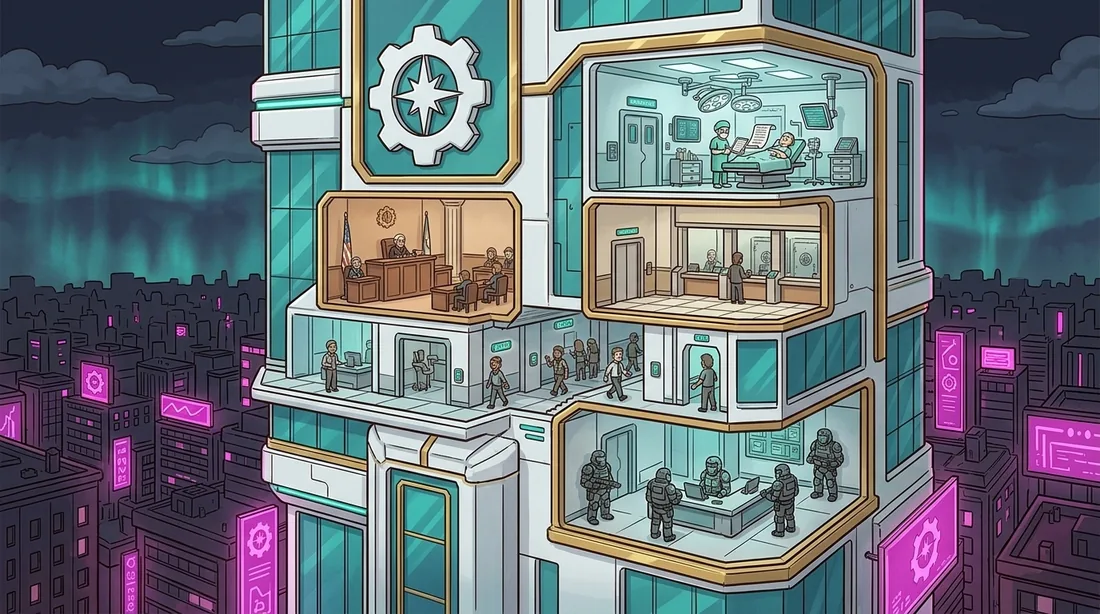
The courts and the hospitals all carried the same corporate name. Get hurt, and the corporation patched you up, then wrote the cost onto your wrist as days of labor owed instead of money.
If a door stayed shut, the corridor billboard displayed that family's name and how many days they owed. No corporate ambulance would stop for a house behind on its days, so the door usually opened by the next morning.
Then, in the year Isela fell ill and could not work, the days on Isela's own wrist fell behind. Isela woke up in a hospital bed with a stitched-up scar along one side, and the wrist read fewer days owed, exactly the price of one kidney.
Even in the settlement, Isela keeps that wrist covered with long sleeves.
Kim Seoyeon
HomeTotalitarian Planet·Former work Matchmaker·Why they left Marriage called off
Concept art
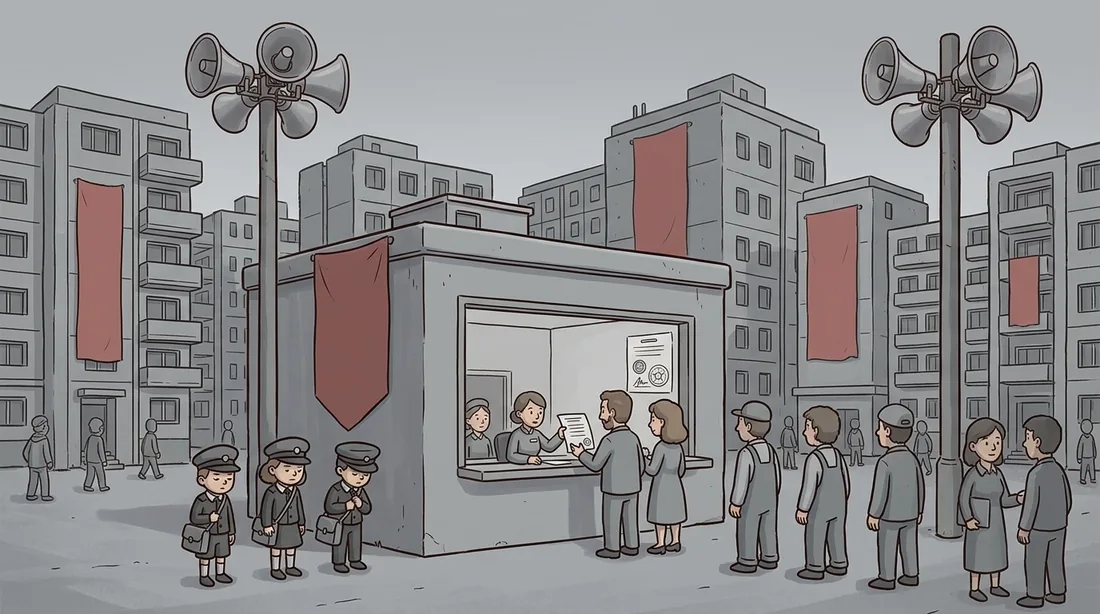
Seoyeon was a matchmaker who sat at a window in a gray apartment block, writing the names of two strangers side by side on a single form.
The Party decided both partners and jobs. Two stamps on the paper made a marriage, and the next day the corridor loudspeaker read out the names of the new couple.
Anyone who refused their match got one more form, ordering them to a distant district. That paper passed through Seoyeon's hands too.
Then Seoyeon's own marriage papers came back missing one stamp. From the day the loudspeaker read out just the word voided, with no reason given, no one in the corridor would meet Seoyeon's eyes.
Even now, whenever someone calls out a name loudly, Seoyeon's shoulders tense first.
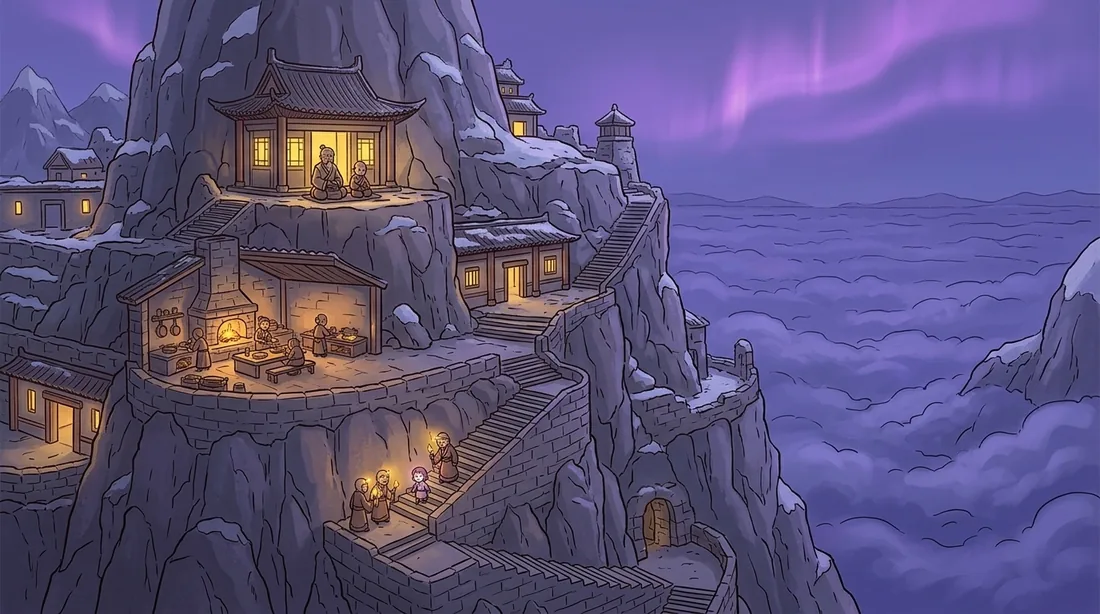
Master Tilne's whole day went into sitting across from a disciple on the floor of a mountaintop monastery, breathing in time together.
The power of the mind passed on only when a master sat beside a disciple, year after year. Whenever the power woke in a child from some house down the mountain, the masters brought the child up and gave them a new name.
Those without the power cooked in the monastery kitchen and washed the disciples' clothes. Then the master who had been teaching Tilne died before passing on everything.
No one left on the mountain knew what came next, and Tilne came down the stone steps with nothing left to pass on to a disciple. Even now, whenever Tilne sits beside someone, Tilne matches breath to theirs.
A different settler appears every day. Names are drawn from the name list in the game and have no connection to real people.
07 · Steam
Steam page Opening in November
Once it opens, the link will go here. The release date has not been set yet.